Tel:+86-512-53640771-125 E-mail: export@alumag.com.cn
- All
- Product Name
- Product Keyword
- Product Model
- Product Summary
- Product Description
- Multi Field Search

Views: 0 Author: Site Editor Publish Time: 2026-08-01 Origin: Site


Engineers face a frustrating paradox when working with ultra-high-strength alloys. The material offers an exceptional strength-to-weight ratio that easily rivals structural steel. However, traditional thermal assembly methods routinely destroy its localized metallurgical integrity. You cannot simply weld these aerospace-grade materials using standard fabrication techniques. Doing so introduces catastrophic financial, operational, and safety risks.
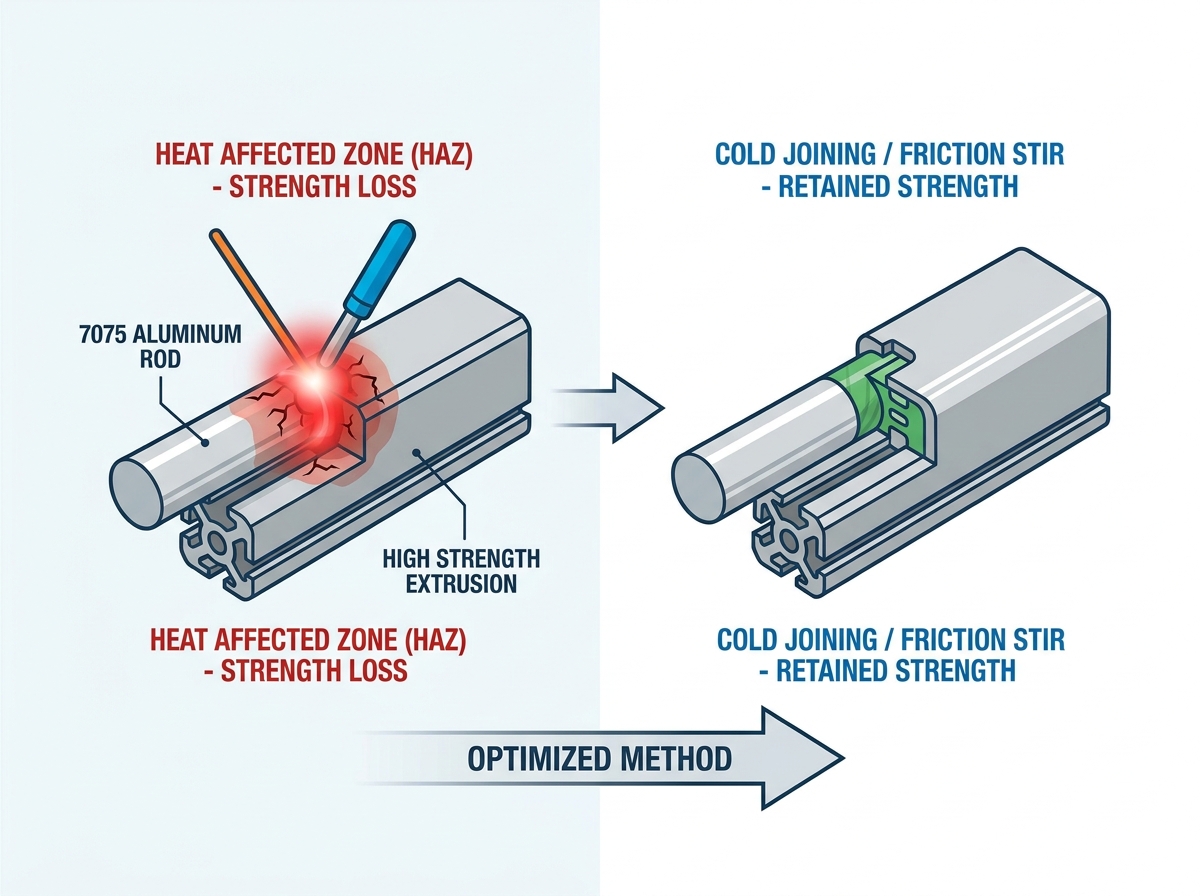
Standard fusion welding methods like TIG and MIG vaporize volatile alloying elements. Zinc boils off rapidly under the arc. This thermal shock causes severe hot cracking. It permanently degrades the carefully engineered T6 temper. Engineers often see up to a 50% loss of tensile strength in the Heat-Affected Zone (HAZ). Joint failure becomes almost inevitable under cyclic loading.
Solving this requires a rigorous, application-specific evaluation framework. You must explore alternative joining methods to preserve raw mechanical properties. Mechanical fastening, solid-state welding, and structural adhesives offer viable pathways. Evaluating these methods ensures high-stress components maintain their structural integrity in the field.
Standard fusion welding is unviable for high-copper, aerospace-grade alloys like 7075 due to micro-segregation, hot cracking, and severe HAZ strength degradation.
Mechanical fastening remains the premier aerospace standard for 7000 series alloys, provided rigorous galvanic isolation measures are applied.
Friction Stir Welding (FSW) delivers the highest joint efficiency for continuous seams, preserving 80-90% of parent material strength by remaining in a solid-state regime below the melting temperature.
"Designing out the joint" by specifying a single complex, high strength aluminum extrusion or machining a monolithic part from a solid 7075 aluminum rod is often the most cost-effective and risk-averse engineering strategy.
Wear-resistant hardcoatings, while beneficial, introduce surface micro-cracks that can severely degrade the fatigue and bending strength of cyclic-loaded 7000-series joints if not mitigated.
Establishing baseline mechanical benchmarks is critical for high-performance structural joints. You must evaluate high bending strength, dynamic fatigue resistance, and surface wear resistance. A successful joint must transfer loads seamlessly across the assembly. It cannot act as a weak link under dynamic stress. Engineers must validate these parameters through rigorous physical testing. When dealing with 7000 series aluminum, the margin for error shrinks considerably compared to softer 6000 series grades. Every hole drilled and every surface prepped dictates the final fatigue life of the assembly.
We look at specific metrics during validation. Ultimate Tensile Strength (UTS) retention across the joint interface is the primary indicator of success. We also measure crack propagation rates under high-cycle fatigue loading. If a joint design forces the load path through a thermally degraded zone, the assembly will fail prematurely regardless of the bulk material properties.
The primary alloying elements dictate the mechanical behavior of this metal family. Zinc typically comprises 5-6% of the composition. Magnesium works alongside zinc to enable precipitation hardening. This thermal process forms GP zones and finely dispersed η' precipitates. These microstructural features block dislocation movement, creating immense strength. However, these same elements render the alloy highly sensitive to thermal cycles.
When you apply heat, you disrupt this carefully balanced internal structure. The zinc and magnesium atoms migrate. They clump together or dissolve back into the aluminum matrix. This destroys the precipitation hardening effect. You are left with a localized area that behaves more like dead-soft aluminum than an aerospace-grade structural component.
Different grades serve distinct structural purposes across engineering disciplines. 7075 remains the classic aerospace workhorse for lightweight, high-stress applications. Grade 7050 offers improved stress corrosion cracking resistance. It also maintains better fracture toughness in thick plate sections. High-performance powder-metallurgy alloys like 7093 push boundaries further. They exhibit yield strengths roughly 30% harder than mild steel. Yet, they share the identical joining vulnerabilities of the broader alloy family.
Understanding these distinctions helps in specifying the right material for the operational environment. If you are designing a thick bulkhead, 7050 prevents the quench-induced residual stresses common in thick 7075 sections. If you need absolute maximum yield strength for a small, highly loaded bracket, 7093 might be the answer. But in all cases, you cannot hit them with a welding torch.
Over-aging destroys the carefully crafted internal structure of the metal. Temperatures exceeding 300°F (150°C) trigger rapid microstructural changes. The vital η' strengthening precipitates coarsen or dissolve entirely into the matrix. This thermal damage permanently destroys the T6 or T73 temper. The resulting HAZ becomes a localized soft spot prone to immediate yielding under load.
This degradation is not reversible through simple room-temperature aging. Once you over-age the material during a botched welding attempt, you must perform a full solution heat treatment and artificial aging cycle to recover the properties. For large structural assemblies, this is physically impossible due to furnace size constraints and the guarantee of severe thermal distortion during the quench phase.
Environmental factors severely complicate joint design in high-strength alloys. Sustained residual tensile stresses often surround mechanically fastened or welded joints. Atmospheric moisture or halide exposure attacks these stressed regions. Intergranular cracking propagates rapidly along the grain boundaries. This failure mode proves especially dangerous along the short transverse (ST) grain direction.
SCC failures are insidious. They occur without warning and often under loads well below the material's yield strength. The combination of a susceptible microstructure, a corrosive environment, and sustained tensile stress creates a perfect storm. Joint designs must actively mitigate at least one of these three factors to ensure long-term survival.
Mechanical fastening joins components via rivets, interference-fit bolts, or lockbolts. This process occurs entirely without thermal input. It represents the most reliable method for critical flight structures. You drill a hole, prep the surface, and install the hardware. The physics are straightforward and highly predictable.
The advantages are significant for structural integrity. The process introduces zero heat input. It retains 100% of the parent material's original temper. Engineers can easily join dissimilar metals. The method also allows for straightforward non-destructive field inspection. You can visually verify a driven rivet or check the torque on a bolt.
However, mechanical fastening carries distinct engineering drawbacks. It introduces localized stress concentrations at fastener holes. The hardware adds parasite weight to the final assembly. You must ensure tight-tolerance hole preparation. Poor hole quality leads to premature fatigue cracking under cyclic bending. A scratched or out-of-round hole acts as a massive stress riser, initiating cracks that will eventually tear the joint apart.
Friction Stir Welding operates entirely in the solid state. The process utilizes a non-consumable, rotating tool pin and shoulder. This tool plasticizes and forges the joint interface just below the melting point. It mechanically mixes the metal without liquefying it. This bypasses the entire liquid-to-solid phase change that causes so many problems in high-strength aluminum.
FSW eliminates solidification cracking and dangerous gas porosity. It drastically minimizes the width of the HAZ. The joint retains 80-90% of base metal tensile strength. It creates flush, highly cosmetic seams ideal for joining a high strength aluminum extrusion. The resulting microstructure in the stir zone is often fine-grained and highly resistant to fatigue.
The primary limitation involves equipment scale and geometry. FSW demands massive, rigid fixturing to withstand extreme forge forces. Initial capital expenditure remains exceptionally high. The process is largely restricted to simple joint geometries, primarily linear or circumferential butt joints. You cannot easily FSW complex, multi-axis intersections in the field.
Chemical bonding utilizes aerospace-grade two-part epoxies or toughened acrylics. These adhesives cure to form resilient, load-bearing polymer chains between substrates. They offer a fundamentally different approach to load transfer. Instead of concentrating stress at a single point like a rivet, adhesives spread the load across a wide surface area.
Adhesives provide extremely even stress distribution across the entire bond line. This eliminates point-source stress risers common in riveted joints. The adhesive layer acts as an inherent dielectric barrier against galvanic corrosion. The process causes zero heat-induced metallurgical damage. It is an excellent choice for joining thin skins to heavier substructures.
Structural adhesives require meticulous process control. They are highly sensitive to substrate surface chemistry and cleanliness. Bonds remain vulnerable to peel, cleavage, and environmental degradation from humidity or UV exposure. Inspecting bond integrity using traditional NDT methods proves notoriously difficult. A bond might look perfect on the outside but have zero adhesion at the microscopic level due to poor surface prep.
You must understand the critical structural difference between unweldable and weldable grades. Unweldable grades include 7075 and 7050 due to high copper content. Weldable grades like 7005 and 7020 contain lower copper levels. This specific chemistry allows them to naturally age back to near-parent strength after thermal exposure. They are the exception to the rule in this alloy family.
Filler metal selection dictates the success of weldable grades. You must specify high-magnesium filler wires like 5356 or 5183. These fillers prevent solidification cracking during the cooling phase. They ensure the weld pool maintains sufficient ductility to handle contraction stresses. Even with these weldable grades, you still lose significant strength in the HAZ immediately after welding, requiring time or artificial heat to recover.
Ultimate tensile strength (UTS) retention varies wildly between joining methods. Mechanical joints retain full parent strength but suffer from hole-induced stress risers. FSW joints retain up to 90% UTS with excellent fatigue resistance. Adhesive joints perform exceptionally well under shear but fail rapidly under peel stresses. You must map out these performance curves against your specific high-cycle dynamic loading requirements.
Fatigue life often dictates the final decision. A mechanically fastened joint might have a higher static ultimate strength, but an FSW joint might survive ten times as many load cycles before initiating a crack. Understanding the operational load spectrum is mandatory before selecting a joining process.
Financial feasibility dictates method selection on the factory floor. FSW machinery requires a massive initial capital barrier. However, it offers low consumable costs for high-volume linear runs. Mechanical fastening requires lower initial equipment investment. Yet, it demands high operational costs through labor, precision drilling, and surface prep consumables. Aerospace bonding requires climate-controlled facilities and strict shelf-life management.
Joining Method | Strength Retention | Fatigue Resistance | Primary Application |
|---|---|---|---|
Mechanical Fastening | 100% (Parent Material) | Moderate (Hole Stress) | Aerospace, Field Assembly |
Friction Stir Welding | 80% - 90% | High | Linear Seams, Tanks |
Structural Adhesives | Variable (Shear vs Peel) | High (Even Distribution) | Thin Panels, Mixed Metals |
Fusion Welding (7005 only) | 60% - 75% (Post-aging) | Low to Moderate | Bicycles, Sporting Goods |
Aerospace and automotive engineers constantly battle weight payload trade-offs. Mechanical fasteners and overlapping lap joints add significant mass to an assembly. Autogenous FSW seams eliminate overlapping material entirely. Thin-film adhesive bonds offer the highest structural efficiency for panel assemblies. You must calculate the exact weight penalty of your chosen joint geometry.
Every ounce matters in high-performance applications. If you specify a heavy bolted flange where an FSW butt joint would suffice, you are leaving performance on the table. Conversely, if you try to save weight by using adhesives in a high-peel environment, the structure will fail.
Designers sometimes treat high-strength structural components like architectural 6000-series frames. This error leads to catastrophic failure risks. You cannot specify fusion-welded joints on structural safety equipment based on architectural drawings. Heavy-duty guardrails, load-bearing cranes, or vehicle chassis require strict metallurgical oversight. Overlooking these principles guarantees premature field failures.
We see this constantly in the field. A fabricator assumes they can TIG weld a 7075 bracket just like they weld 6061 tubing. The weld looks fine visually, but the HAZ is completely destroyed. The bracket snaps off under the first heavy load. You must enforce strict material control and process specifications to prevent these dangerous assumptions.
Designing out the joint entirely represents the ultimate engineering solution. Calculate the break-even point of machining a complex, single-piece component. High-speed CNC milling can carve intricate parts directly from a solid 7075 aluminum rod. This approach eliminates multi-part welded assemblies. It removes all joining risks, inspection costs, and weak points.
Modern 5-axis machining centers make monolithic design highly practical. While the initial material waste (swarf) is high, the reduction in assembly labor, fixturing, and inspection often makes it the cheaper option overall. More importantly, a monolithic part has continuous grain flow and zero joint-induced stress risers.
Custom extrusion profiles drastically reduce the need for intermediate joints. You can integrate complex geometric designs directly into the die. Interlocking snap-fits or integrated sliding channels eliminate reliance on external fasteners. Smart profile design consolidates parts and streamlines the final assembly process.
By pushing the complexity into the extrusion die, you simplify the shop floor operations. A well-designed extrusion can replace three separate plates and dozens of rivets. This reduces weight, cuts assembly time, and eliminates potential failure points.
Temper selection heavily influences environmental durability. The T6 temper provides peak strength but lower SCC resistance. The T73 temper is artificially over-aged to provide superior SCC resistance. Specifying a T73 temper is critical for mechanically fastened components in marine environments. You accept a 10-15% drop in absolute yield strength to guarantee long-term survival against corrosion.
This is a necessary trade-off. A T6 part might look better on a static stress analysis report, but if it cracks after six months in a salty environment, it failed its primary mission. The T73 temper stabilizes the microstructure, preventing the intergranular attack that destroys highly stressed joints.
Dissimilar metal contact creates a highly active galvanic cell. Steel or titanium fasteners reacting with aluminum lead to rapid pitting and joint degradation. Moisture acts as the electrolyte to accelerate this destruction. The aluminum acts as the anode and sacrifices itself to protect the fastener.
Mitigation requires strict wet-installation protocols. Use sacrificial zinc-chromate or epoxy primers during assembly. Specify cadmium-plated or passivated fasteners. Apply isolating non-conductive washers to break the electrical connection between the metals. You must physically separate the dissimilar metals to stop the galvanic current.
Hardcoat anodizing (MIL-A-8625 Type III) enhances surface wear resistance. However, this brittle aluminum oxide layer naturally develops micro-cracks under load. These cracks act as severe stress risers. They reduce the fatigue life and bending strength of the joint by up to 50%.
You must mask critical joint interfaces from the hardcoating process. Protect high-stress radiused areas from the anodic bath. Alternatively, apply post-anodize duplex sealants. These sealants lubricate micro-fissures and inhibit crack propagation under dynamic loading. Never hardcoat a highly stressed fastener hole if you expect it to survive cyclic fatigue.
Adhesion failure often results from the unstable, natural aluminum oxide layer. Peeling occurs when adhesives bond to loose surface oxides rather than the base metal. This renders the structural bond useless. The adhesive simply pulls the oxide layer right off the aluminum substrate.
Implement strict pre-bond surface prep protocols. Begin with solvent degreasing followed by mechanical abrasion. Finish with Phosphoric Acid Anodizing (PAA) or apply organo-silane adhesion-promoting primers. This creates a stable, chemically active surface for the epoxy. The bond is only as strong as the surface preparation.
Attempting to recover strength in a welded 7005 assembly through PWHT carries massive risks. Solution heat treatment and artificial aging require precise furnace controls. The process often induces severe thermal warping in complex geometries. You heat the part to near melting, then quench it rapidly in water. The thermal shock is violent.
Acknowledge the practical limitations of PWHT on large structural assemblies. Residual stress development during quenching can distort the frame beyond repair. Furnace size constraints often make full-assembly heat treatment logistically impossible. If you cannot fit the entire welded assembly into the quench tank, you cannot perform a proper PWHT.
Joining these ultra-high-strength alloys successfully requires abandoning conventional fusion-welding mindsets. You must prioritize mechanical isolation, solid-state friction processes, or advanced chemical bonding. Evaluate your specific load paths, environmental exposures, and production volumes before finalizing a joint design.
Choose Friction Stir Welding for continuous, high-efficiency structural linear joints.
Choose Mechanical Fastening for field-serviceable, multi-material assemblies requiring 100% parent temper retention.
Choose Structural Adhesives for weight-critical, low-peel applications requiring uniform stress distribution.
Choose Monolithic Machining to completely eliminate the risk of joint failure in highly critical components.
A: TIG welding 7075 vaporizes the zinc alloying elements, causes severe hot cracking during solidification, and permanently destroys the T6 temper. The resulting joint will possess a fraction of the base metal's strength and fail under load.
A: Mechanical fastening using aerospace-grade rivets or lockbolts remains the industry standard. It introduces zero heat, retains the full temper of the parent material, and allows for reliable non-destructive inspection.
A: FSW retains 80-90% of the parent material's strength. Because it operates below the melting point, it prevents the severe microstructural degradation and gas porosity associated with traditional fusion welding.
A: You must isolate the dissimilar metals to prevent galvanic corrosion. Use wet-installation techniques with epoxy primers, specify passivated or coated fasteners, and install non-conductive dielectric washers.
A: Yes, 7005 is a weldable grade that can naturally age at room temperature to recover strength. Artificial post-weld heat treatment (PWHT) accelerates this, but risks severe thermal warping in complex assemblies.