Tel:+86-512-53640771-125 E-mail: export@alumag.com.cn
- All
- Product Name
- Product Keyword
- Product Model
- Product Summary
- Product Description
- Multi Field Search

Views: 0 Author: Site Editor Publish Time: 2026-07-28 Origin: Site


Zinc-alloyed aerospace grades provide excellent strength-to-weight ratios for structural engineering. However, Stress Corrosion Cracking (SCC) stands as the primary catastrophic failure risk in high-stress applications, particularly in safety-critical aircraft structures. We must frame SCC not just as a chemical reaction, but as a severe engineering liability. Unpredicted brittle failures in load-bearing components lead to safety hazards, recalls, and extensive redesigns.
When components operate under immense loads, the intersection of material properties and environmental exposure can lead to sudden fractures. A failure in a structural spar or bulkhead compromises system integrity, demanding strict material oversight from the initial design phase. Mitigating SCC requires a precise understanding of microstructural vulnerabilities, environmental triggers, and strategic temper selection during material specification and procurement. By controlling grain orientation and managing residual stresses, engineers can harness the strength of these advanced alloys while neutralizing the risk of cracking.
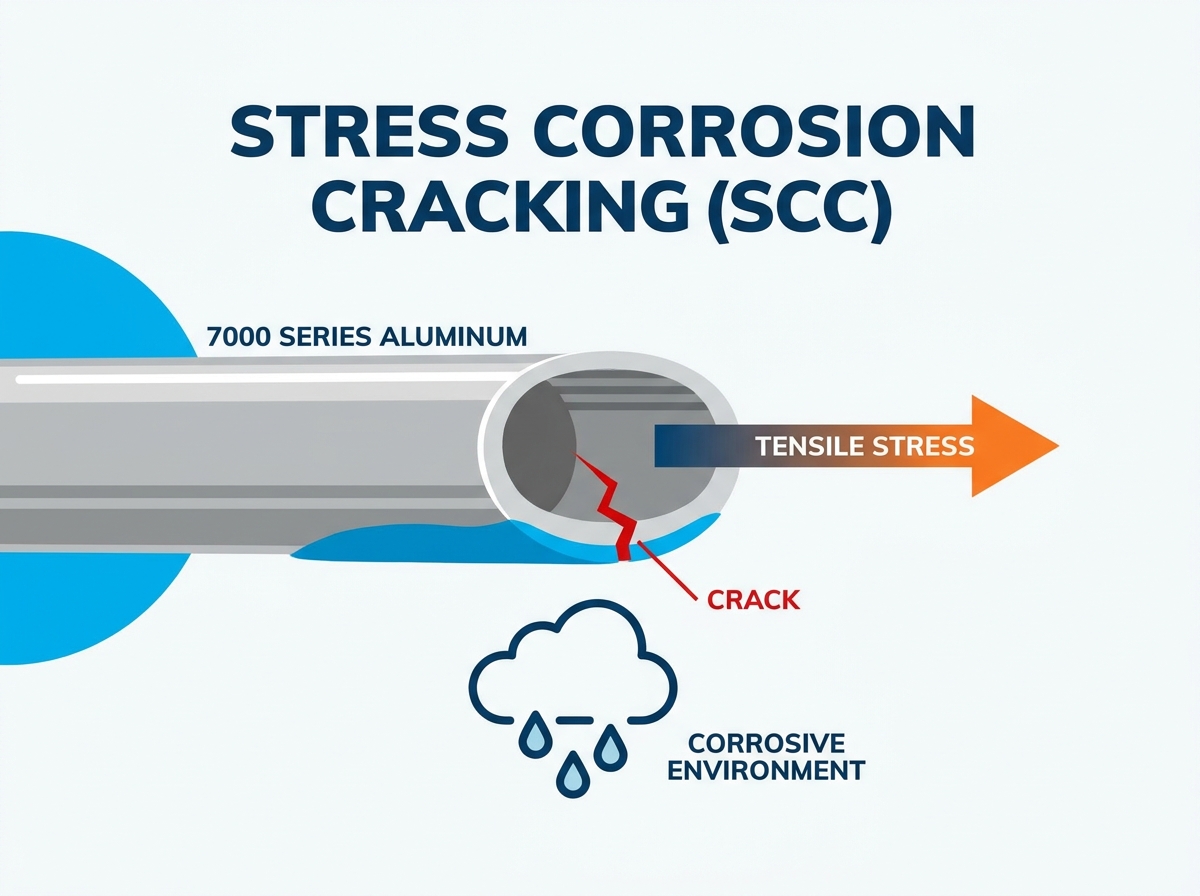
SCC in 7000 series aluminum alloys requires three simultaneous conditions: a susceptible microstructure, sustained tensile stress, and a specific corrosive environment.
The peak-strength -T6 temper condition is highly susceptible to SCC, particularly when tensile stresses align with the short transverse grain direction.
Overaged tempers (such as -T73 or -T76) significantly increase SCC resistance, though engineers must account for a 10–15% reduction in yield strength.
Material form matters: specifying the correct grain orientation in a high strength aluminum extrusion or utilizing stress-relieved 7075 aluminum rod is critical for long-term component viability.
Stress corrosion cracking never occurs in isolation. It requires the mandatory intersection of three specific factors: a susceptible alloy state, sustained residual or applied tensile stress, and a corrosive environment. Even ambient moisture or standard atmospheric exposure can act as a sufficient electrolyte to trigger the reaction. If any one of these three conditions is removed, SCC cannot propagate. This fundamental principle forms the basis of all metallurgical mitigation designs. Engineers focus on altering the microstructure, reducing tensile loads, or isolating the metal from electrolytes to prevent failure.
In field applications, identifying these prerequisites early prevents catastrophic failures. We often see components fail because design teams accounted for applied loads but ignored residual stresses from manufacturing. A comprehensive mitigation strategy addresses all three areas simultaneously.
Identify the exact alloy and temper state to determine baseline microstructural susceptibility.
Map all sources of tensile stress, including operational loads, assembly interference fits, and residual manufacturing stresses.
Evaluate the operating environment for moisture, chlorides, and temperature fluctuations that act as electrolytes.
The specific chemistry of the Al-Zn-Mg-Cu system dictates its mechanical properties and corrosion resistance. The ratio of zinc, magnesium, and copper directly influences the alloy's susceptibility to cracking. During the aging process, zinc and magnesium form precipitates along the grain boundaries. These precipitates, primarily MgZn2 (known as the eta-phase), are highly anodic compared to the surrounding aluminum matrix. This electrochemical imbalance creates a microscopic galvanic cell right at the grain boundary.
Copper content plays a major role in modifying the electrochemical behavior of these grain boundaries. Alloys containing higher copper levels exhibit improved SCC resistance compared to copper-free 7xxx alloys. The copper alters the potential difference between the grain boundary precipitates and the matrix. When an electrolyte is present, anodic dissolution occurs at these boundaries. This localized galvanic corrosion leads to Intergranular Corrosion (IGC), which acts as the microscopic precursor to deep, structural cracking under stress.
Alloy Grade | Zinc (Zn) % | Magnesium (Mg) % | Copper (Cu) % | Primary Application Focus |
|---|---|---|---|---|
7075 | 5.1 - 6.1 | 2.1 - 2.9 | 1.2 - 2.0 | Aerospace structures, high-stress parts |
7050 | 5.7 - 6.7 | 1.9 - 2.6 | 2.0 - 2.6 | Thick plate applications, high SCC resistance |
7049 | 7.2 - 8.2 | 2.1 - 3.1 | 1.2 - 1.9 | Forgings requiring high static strength |
Crack propagation in 7xxx alloys is primarily driven by two distinct but interacting mechanisms: anodic dissolution and hydrogen embrittlement. Anodic dissolution involves the active removal of metal at the grain boundaries due to localized galvanic cells. The anodic precipitates dissolve into the electrolyte, leaving a physical void that concentrates stress. Simultaneously, the corrosion reactions at the crack tip generate hydrogen atoms.
These highly mobile hydrogen atoms diffuse into the plastic zone ahead of the advancing crack. Once inside the metal lattice, they weaken the atomic bonds, accelerating brittle intergranular fracture. Understanding both mechanisms is essential for designing effective protective treatments. You cannot simply block the dissolution; you must also prevent hydrogen generation at the surface.
Aluminum naturally forms a protective aluminum oxide passive film. However, this film is highly unstable when exposed to specific alkaline, acidic, or halide environments, particularly those containing chlorides. Localized pitting breaks down the oxide film, exposing the bare metal underneath. These microscopic pits create severe stress concentrations that serve as the primary initiation sites for cracks. Once a pit forms, the local chemistry inside the pit becomes highly acidic, further accelerating the attack.
Operating temperature significantly influences both the thermodynamic and kinetic aspects of SCC. Elevated temperatures accelerate chemical reaction rates at the metal surface and increase the rate of hydrogen diffusion into the lattice. Components operating in hot, humid, or marine environments experience a drastically shortened time-to-failure compared to those in controlled, dry conditions. We see this frequently in aerospace components housed near engine exhaust zones or unconditioned landing gear bays.
Environment Type | Electrolyte Source | Relative SCC Risk Level | Typical Mitigation Approach |
|---|---|---|---|
Marine / Coastal | Airborne chlorides, salt spray | Very High | Overaged tempers, heavy anodizing, sealants |
Industrial | Sulfates, acidic rain, pollutants | High | Protective coatings, regular washdowns |
Controlled Indoor | Ambient humidity | Low to Moderate | Standard tempers, basic surface protection |
Physical damage and part geometry heavily influence crack initiation. Machining marks, scratches, or handling damage act as initial nucleation sites by concentrating applied loads. Even on undamaged, perfectly smooth surfaces, cracks can initiate around critical geometric features. Sharp fillet radii, counterbores, and fastener holes naturally multiply local stresses. A poorly designed radius can increase the local stress by a factor of three or more, easily pushing the material past its SCC threshold.
Assembly practices also introduce risk. Forcing components together with mismatched tolerances introduces unintended, permanent residual tensile stress across joints. When these assembly stresses combine with operational loads and environmental exposure, the threshold for SCC is easily exceeded. Proper tolerancing and assembly techniques are just as important as material selection.
Specify generous fillet radii on all internal corners to distribute stress evenly.
Mandate strict surface finish requirements (e.g., Ra 63 or better) in high-stress zones.
Avoid interference fits in the short transverse grain direction.
Implement strict handling protocols to prevent surface scratches during transit and assembly.
Wrought high-strength aluminum exhibits highly directional, anisotropic properties. The grain structure is elongated during rolling or forging, creating distinct longitudinal, long transverse, and short transverse directions. Exposing the short transverse (ST) grain direction to tensile stress is the most common cause of SCC failure. In thick plates, hand forgings, and die-forgings, the ST plane presents a direct, continuous path for intergranular cracks to propagate rapidly through the material thickness.
Engineers must map the grain flow of the raw material onto the final machined part. If the primary operational loads pull across the ST grains, the part will likely fail prematurely in a corrosive environment. Redesigning the part to align loads with the longitudinal grains is the most effective mechanical mitigation strategy.
The extrusion process forces metal through a die, severely elongating the grain structures along the axis of material flow. This makes the longitudinal direction highly resistant to SCC. When designing a high strength aluminum extrusion, operational loads must align with the longitudinal or long-transverse axes to avoid ST exposure.
Complex extrusion cross-sections carry specific risks. The outer surface of an extrusion often experiences different cooling rates and deformation levels than the core, leading to a recrystallized surface layer. This layer can exhibit isotropic vulnerability, requiring careful machining and surface treatment strategies to maintain integrity. When specifying extrusions, always request grain structure analysis from the mill to verify the depth of any recrystallized zones.
Heavy machining of raw stock exposes vulnerable end-grains and parting lines. When working with a 7075 aluminum rod, aggressive material removal can release unbalanced residual stresses, causing the part to warp or become susceptible to cracking. The outer layers of a rod often hold compressive stresses from the quenching process, while the core is in tension. Machining away the outer layer exposes the tensile core.
Specifying stress-relieved tempers, such as -T651 or -T7351, is mandatory when extensive machining is required. These tempers involve a controlled stretching operation after quenching, which equalizes internal stresses and prevents distortion during final manufacturing. Always ensure your machine shop understands the importance of balanced material removal to maintain the stress-relieved state.
The -T6 peak aged condition offers maximum tensile and yield strength, making it attractive for weight-critical designs. However, this temper leaves the microstructure highly susceptible to SCC. The continuous network of anodic precipitates along the grain boundaries provides an uninterrupted path for corrosion. The use of -T6 must be restricted to narrow, risk-managed applications.
Acceptable use-cases include thin sheet sections where ST stresses are negligible, hermetically sealed environments, or components subjected purely to compressive loads. If you specify -T6 for a thick structural component exposed to the elements, you are virtually guaranteeing a future failure. The strength benefits do not outweigh the catastrophic risks in these scenarios.
To combat SCC, metallurgists utilize overaging techniques. Overaging involves extending the artificial aging process at elevated temperatures to coarsen the grain boundary precipitates. This alters the precipitate size and distribution, breaking up the continuous anodic network and halting localized anodic dissolution. The precipitates become larger and spaced further apart, disrupting the continuous galvanic cell.
Different overaged tempers serve specific engineering needs. The -T73 temper provides maximum SCC resistance, making it the standard for critical structural forgings. The -T76 temper is optimized for exfoliation corrosion resistance, often used in aircraft skins. The -T74 temper offers a balanced compromise, providing better strength than -T73 while maintaining near-immunity to SCC.
Temper Designation | Aging Process | Yield Strength Retention (vs T6) | SCC Resistance Level |
|---|---|---|---|
-T6 | Peak Aged | 100% (Baseline) | Poor |
-T76 | Slightly Overaged | ~90-95% | Moderate (Good Exfoliation Resistance) |
-T74 | Moderately Overaged | ~85-90% | Very Good |
-T73 | Fully Overaged | ~80-85% | Excellent (Near Immune) |
Selecting an overaged temper requires a calculated engineering trade-off. The -T73 temper typically incurs a 10-15% reduction in yield strength compared to -T6. Engineers must calculate whether this strength penalty requires a component redesign, such as increasing wall thickness or adding structural ribs.
In safety-critical applications, the increased reliability and extended service life easily justify the slight reduction in ultimate yield strength. You must evaluate the load paths and determine if the component is actually strength-limited or fatigue-limited. In many cases, the fatigue requirements dictate a geometry that easily accommodates the lower yield strength of a -T73 temper.
Surface treatments provide a physical and mechanical barrier against SCC. Shot peening and laser shock peening are highly effective methods for introducing deep residual compressive stresses on the material surface. Because SCC requires tensile stress to open and propagate cracks, this layer of compressive stress effectively neutralizes applied surface tensile loads. The crack simply cannot initiate if the surface remains in compression.
Additionally, isolating the metal substrate from corrosive electrolytes is necessary. Anodizing creates a thicker, more durable oxide layer, while metal cladding bonds a layer of pure, corrosion-resistant aluminum to the alloy core. Organic protective coatings and specialized primers provide a final line of defense against moisture and chlorides. A multi-layered approach, combining peening with a robust coating system, yields the best field results.
Design protocols must actively eliminate sources of residual tensile stress. Engineers should avoid high-tolerance press fits, interference fits, and overtightened fasteners, especially when these forces act upon susceptible grain directions like the short transverse. Assembly procedures should utilize clearance fits and proper torque specifications.
After severe forming or welding operations, stress-relief thermal treatments are recommended to reduce internal residual stress states before the component enters service. If a part must be cold-formed during installation, ensure the resulting stresses do not exceed the established SCC thresholds for that specific temper.
Review all assembly drawings to identify potential interference fits.
Specify torque limits for all fasteners passing through 7xxx series components.
Require stress-relief operations for any parts subjected to heavy cold working.
Implement strict inspection protocols to verify surface compressive layers after peening.
Material integrity begins with strict sourcing protocols. Evaluating material suppliers and verifying thermal treatment histories ensures the alloy performs as designed. Procurement teams must request precise mill test reports (MTRs) to verify chemistry and mechanical properties. Do not accept generic certifications; demand lot-specific data.
It is critical to verify stress-relief processes, indicated by designations like -Tx51 (stretching) or -Tx52 (compressing). Strict adherence to Aerospace Material Specifications (AMS) or ASTM standards guarantees the aluminum meets the rigorous demands of high-stress applications. Regular audits of your supply chain will prevent substandard materials from entering your production line.
Audit your current material specifications to ensure -T6 tempers are only used in environments completely isolated from corrosive elements and tensile stress.
Update your procurement guidelines to mandate overaged tempers (-T73 or -T74) for all load-bearing structural components exposed to ambient or harsh environments.
Implement mandatory grain flow analysis during the design phase to guarantee operational loads never align with the short transverse direction.
Establish a strict surface treatment protocol, incorporating shot peening and protective coatings, for all parts operating in marine or high-chloride environments.
A: The -T6 peak-aged condition creates a continuous network of anodic precipitates along the grain boundaries. When exposed to tensile stress and a corrosive environment, these boundaries undergo rapid localized galvanic corrosion, allowing cracks to propagate easily through the material.
A: The -T6 temper provides maximum strength but high SCC susceptibility. The -T73 temper is overaged, meaning it is heat-treated longer to coarsen grain boundary precipitates. This breaks the continuous corrosion path, vastly improving SCC resistance at the cost of a 10-15% reduction in strength.
A: Wrought aluminum has directional grains. The short transverse (ST) direction is the weakest and most vulnerable to SCC. Tensile stresses applied across the ST plane easily pull the elongated grain boundaries apart, leading to rapid failure.
A: Anodizing helps by creating a thick protective oxide layer that isolates the metal from corrosive electrolytes. However, if the anodized layer is scratched or compromised, localized pitting can still occur, meaning it must be combined with proper temper selection for full protection.
A: Environments containing moisture, chlorides (like marine atmospheres or road salt), acidic, or alkaline solutions act as electrolytes. Even high humidity combined with elevated temperatures can trigger anodic dissolution and hydrogen embrittlement in susceptible extrusions.
A: Testing typically involves ASTM G47 or similar standards, where stressed samples (often in the short transverse direction) are exposed to alternate immersion in a 3.5% sodium chloride solution for a specified period (e.g., 20-30 days) to check for crack initiation.
A: Elevated temperatures accelerate both the chemical corrosion reactions at the surface and the diffusion of hydrogen into the metal lattice. This thermodynamic acceleration drastically reduces the time-to-failure for components operating under stress.