Tel:+86-512-53640771-125 E-mail: export@alumag.com.cn
- All
- Product Name
- Product Keyword
- Product Model
- Product Summary
- Product Description
- Multi Field Search

Views: 0 Author: Site Editor Publish Time: 2026-07-31 Origin: Site


The engineering push for lighter, stronger components frequently leads design teams to specify aerospace-grade alloys, but material selection on paper often clashes with manufacturing realities on the extrusion press. Specifying 7000 series aluminum over the industry-standard 6000 series introduces significant production bottlenecks, including reduced extrusion speeds, accelerated tooling wear, and complex thermal treatments that directly impact lead times and unit costs. To make cost-effective, viable material decisions, engineering and procurement teams must understand the specific metallurgical and mechanical factors that make high strength aluminum extrusion fundamentally more difficult, and evaluate whether the performance gains justify the manufacturing trade-offs.
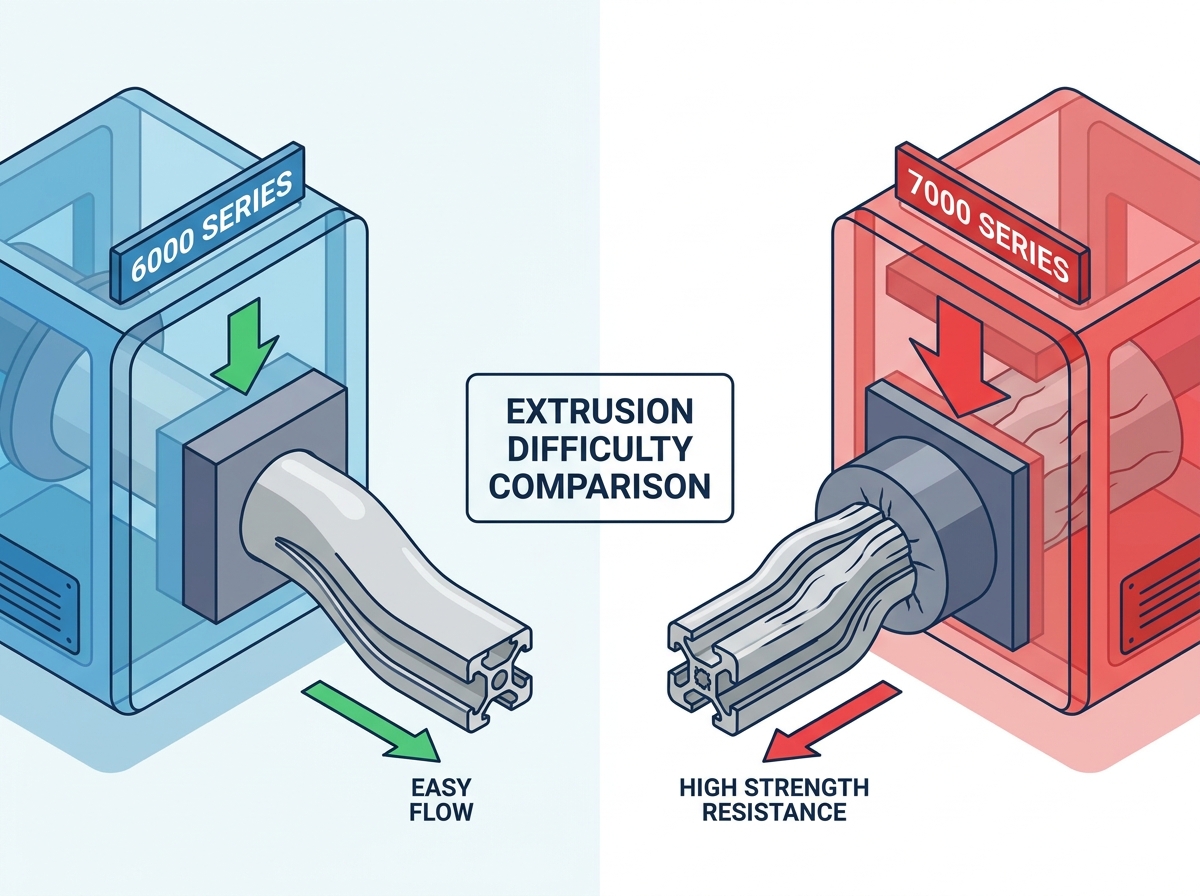
Alloying Elements Dictate Flow: The addition of zinc in 7000 series aluminum drastically increases the material's flow stress, requiring significantly higher press pressures and resulting in much slower extrusion rates compared to the magnesium and silicon mix of the 6000 series.
Thermal Processing Complexity: 7000 series alloys are highly quench-sensitive and require precise, multi-stage artificial aging processes to achieve peak strength, increasing the risk of distortion and extending production timelines.
Profile Limitations: Due to high friction and resistance during extrusion, 7000 series alloys are generally restricted to simpler, thicker-walled profiles (like a standard 7075 aluminum rod or heavy structural bar) rather than the intricate, thin-walled shapes easily achieved with 6000 series.
Production Cost Factors: The combination of slower throughput, higher scrap rates, and accelerated die wear makes 7000 series extrusion exponentially more expensive, requiring strict justification based on end-use structural requirements.
The 6000 series relies on a precise magnesium and silicon composition. This specific blend provides high ductility and low flow stress at standard extrusion temperatures. When heated in the billet furnace, the metal softens predictably. It flows smoothly through intricate die openings without requiring extreme hydraulic pressure. This predictable behavior makes the 6000 series the dominant choice for commercial applications across construction and manufacturing.
Operators favor these alloys for their excellent formability on the press. You can push them through complex dies to create hollows, thin walls, and multi-cavity shapes with minimal scrap. The magnesium-silicide precipitates allow the material to achieve good structural strength post-extrusion without fighting the press during the actual forming process. This balance of workability and final strength keeps production lines moving quickly and efficiently.
Standard architectural alloys like 6063 or structural grades like 6061 forgive minor temperature fluctuations. If the billet temperature drops slightly, the press can usually push through it. The metal fills the die bearings evenly, resulting in straight profiles that require minimal stretching. This wide processing window keeps scrap rates low and output high.
Zinc serves as the primary alloying element in the 7000 series. Secondary elements like magnesium and copper further reinforce the grain structure. This combination creates a dense, highly alloyed matrix designed for maximum mechanical performance. However, this same matrix strongly resists plastic deformation. The billet remains inherently stiff even when heated to optimal extrusion temperatures.
These alloying elements drastically increase the high-temperature flow stress. The metal simply does not want to move through the die. Forcing this rigid material through a steel tool requires immense force. The dense atomic structure fights the extrusion process at every millimeter of travel. This fundamental metallurgical resistance forms the root cause of all subsequent manufacturing challenges on the shop floor.
When you heat a 7075 billet, it does not achieve the same plastic state as a 6061 billet. The zinc and copper lock the grain boundaries. You have to push harder, which generates more internal friction. This friction limits how fast you can run the ram. If you ignore these metallurgical realities, you will break dies and scrap entire production runs.
Metallurgical Comparison: 6000 vs 7000 Series | ||
Property | 6000 Series (e.g., 6061) | 7000 Series (e.g., 7075) |
|---|---|---|
Primary Alloying Elements | Magnesium, Silicon | Zinc, Magnesium, Copper |
Flow Stress at Extrusion Temp | Low to Moderate | Extremely High |
Ductility During Forming | High (Allows complex hollows) | Low (Restricted to simple shapes) |
Quench Sensitivity | Low (Air or light water quench) | High (Requires aggressive water quench) |
Pushing highly alloyed billets through a die requires massive hydraulic force. A standard press pushing 6000 series might operate comfortably at 2,000 tons of pressure. Extruding the same profile in a 7000 series alloy often demands 3,000 tons or more. Many standard extrusion facilities simply lack the press capacity to handle these aerospace-grade materials. The equipment stalls or hydraulic systems fail under the required load.
A direct correlation exists between alloy yield strength and maximum extrusion rate. Speeds for high strength aluminum extrusion drop up to 90% compared to standard alloys. The press must move slowly to overcome the extreme flow stress. Pushing the ram too fast exceeds the machine's hydraulic limits. This physical constraint severely limits daily production output and drives up machine-hour costs.
Operators must monitor breakthrough pressure carefully. When the ram first contacts the billet, the pressure spikes. With 7000 series, this spike can easily exceed the safety limits of older presses. Facilities often have to cut billets shorter to reduce the initial friction surface area inside the container. Shorter billets mean more dead cycle time and lower overall recovery rates.
Material strength and extrusion speed share an inverse relationship. Stronger alloys generate significantly more friction against the die bearing surfaces. This intense friction creates excessive localized heat at the exit point. If the press operator pushes the material too fast, the temperature spikes rapidly. This thermal spike pushes the alloy past its solidus temperature.
Exceeding this temperature threshold causes catastrophic surface tearing. The metal literally rips apart as it exits the die, leaving a rough, jagged finish. High friction also risks severe metallurgical degradation. The grain structure can recrystallize unevenly, destroying the intended mechanical properties. Operators must run the press at a crawl to manage this frictional heat generation.
To control this heat, facilities employ several tactics on the floor:
Lowering the initial billet temperature to allow for frictional heat buildup during the push.
Using liquid nitrogen die cooling systems to extract heat directly from the tool.
Reducing ram speed to a fraction of standard operating parameters.
Applying specialized high-temperature lubricants to the dummy block and die face.
Highly alloyed aluminum behaves abrasively against H13 steel extrusion dies. The dense concentration of zinc, copper, and magnesium scours the die bearing surfaces. This constant abrasion alters the die geometry much faster than standard alloys. Tolerances begin to drift as the die opening gradually widens. Maintaining precise dimensional accuracy becomes a constant battle for the quality control team.
Facilities must replace or repair dies frequently when running these materials. A die shaping 6000 series might last for dozens of production runs before needing correction. The same die profile running 7000 series might require maintenance after just a few pushes. This rapid tooling degradation interrupts production continuity. It forces frequent press shutdowns for die changes and adjustments.
Die correctors spend hours polishing and nitriding tools used for aerospace grades. The nitrided layer wears off quickly under the extreme pressure and friction. Once the hardened layer goes, the underlying steel washes out rapidly. You have to build multiple backup dies for large orders just to keep the press running while worn tools go back to the shop for repair.
Quench sensitivity defines how quickly an alloy must cool to retain its mechanical properties. The 7000 series is notoriously quench-sensitive. The material must drop from extrusion temperature to room temperature almost instantly. This rapid cooling traps the alloying elements in a solid solution. Failing to cool the profile fast enough results in a massive loss of final strength.
Rapidly cooling a hot metal profile introduces severe distortion risks. Blasting the extrusion with high-pressure water at the press exit causes aggressive thermal shock. The material warps, twists, and bows violently on the runout table. Managing this distortion requires heavy stretching and mechanical straightening downstream. These residual internal stresses complicate subsequent machining operations.
Operators use specific quenching techniques to manage this:
High-volume water spray boxes positioned immediately after the die exit.
Submersion tanks for heavy solid profiles that require massive heat extraction.
Forced air quenching combined with water mist for profiles prone to severe warping.
Controlled tension on the puller to keep the profile as straight as possible during the quench.
Tempering standard alloys usually involves a straightforward T6 aging cycle. You place the metal in an oven at a set temperature for a few hours. The 7000 series requires complex, multi-step precipitation hardening. Achieving tempers like T73 for stress-corrosion cracking resistance involves precise thermal cycling. The material must heat, soak, cool, and reheat under strict controls.
These multi-stage aging processes consume massive amounts of time and energy. Cycling the material in and out of aging ovens extends the production timeline by days. A slight deviation in oven temperature can ruin the entire batch. This thermal complexity demands advanced metallurgical control and dedicated oven capacity.
If the oven temperature drifts by even five degrees during a T73 cycle, the material might fail its conductivity tests. Failed conductivity means the alloy remains susceptible to stress corrosion cracking. You then have to scrap the batch or attempt a costly retempering process. The margin for error is practically nonexistent compared to aging 6061.
Low ductility establishes strict design limits for 7000 series extrusions. Thin walls, intricate hollows, and complex heat sinks are highly prone to failure. The material simply cannot flow into tight die corners without tearing. Attempting to extrude delicate features usually results in broken dies or scrapped metal. Designers must abandon complex cross-sections when specifying these alloys.
Viable shapes remain restricted to robust, heavy geometries. Solid structural beams, thick angles, and heavy channels work well. A basic 7075 aluminum rod intended for secondary machining represents a typical successful profile. These simple shapes minimize die friction and allow the stiff material to flow evenly through the tooling.
When engineers insist on hollow 7000 series profiles, they force the use of porthole dies. Porthole dies require the metal to separate and weld back together inside the tool. High-strength alloys resist this solid-state welding. The resulting seam welds are often weak and prone to failure under load. We strongly advise against hollows in these grades.
Machinability differs significantly between the two alloy families. The 6000 series is gummy and can clog cutting tools if not managed properly. The 7000 series behaves as a more free-machining alloy due to its lower ductility. It yields clean, easily managed chips during milling and turning. This chip formation makes chip evacuation highly efficient on CNC centers.
However, the high mechanical hardness makes it significantly more abrasive on CNC cutting tools. Carbide end mills dull much faster when cutting aerospace grades. Machine shops must adjust feeds and speeds to compensate for this hardness. Tool replacement frequency increases, adding complexity to the post-extrusion manufacturing phase.
Machining Characteristics Comparison | ||
Feature | 6000 Series | 7000 Series |
|---|---|---|
Chip Formation | Long, stringy (can clog tools) | Short, brittle (easy evacuation) |
Tool Wear Rate | Low to Moderate | High (Abrasive on carbide) |
Surface Finish Post-Machining | Good | Excellent |
Residual Stress Movement | Minimal | High (Parts may warp during heavy milling) |
Aesthetic outcomes vary wildly based on alloy composition. The 6000 series yields a superior, bright architectural finish. It anodizes beautifully, accepting clear and color dyes with excellent uniformity. This makes it ideal for visible consumer products and building facades. The surface remains smooth and visually consistent after chemical etching.
The 7000 series often presents a darker, less uniform appearance post-anodizing. High zinc and copper content interferes with the anodic layer formation. The resulting finish can appear mottled, grayish, or structurally inconsistent. You should rarely specify these high-strength alloys for purely cosmetic applications.
If you must anodize 7075 for corrosion protection, stick to hardcoat anodizing (Type III). Hardcoat provides a thick, durable oxide layer that masks some of the visual inconsistencies. Do not expect bright, decorative colors. The copper content will turn clear anodize into a muddy yellow or dark gray.
Raw billet costs represent only a fraction of the production equation. The real challenge lies in the exponential increase in machine-hour requirements. Slow extrusion speeds mean a press ties up capacity for much longer periods. A job that takes one shift using standard alloys might take five shifts using high-strength grades. This slow throughput dictates production scheduling and drives up overhead allocation.
Manufacturers must allocate specialized equipment and highly trained personnel for these runs. The extended time on the press directly impacts facility capacity. Lead times stretch out as these slow-moving jobs occupy critical machinery. Engineering teams must account for these extended manufacturing windows when planning project timelines.
Surface defects, tearing, and out-of-tolerance dimensions occur more frequently with rigid alloys. These issues lead to lower overall yield per billet. The probability of scrapping a run increases due to the narrow processing window. High scrap rates force manufacturers to order extra raw material to guarantee final delivery quantities.
Recycling presents a significant circular economy challenge. The presence of zinc necessitates precise alloy sorting. Facilities often use XRF analyzer sorting technology to separate scrap streams. High-strength scrap can easily contaminate standard, highly recyclable 6000 series scrap streams. Mixing these alloys ruins the chemical composition of subsequent recycled batches.
Shop floors must maintain strict segregation protocols. Bins holding 7075 drop-offs cannot sit near 6061 bins. If a single piece of zinc-heavy scrap makes it into a 6000 series remelt furnace, the entire cast gets downgraded. This strict material handling adds labor and logistical complexity to the operation.
Limited availability of capable extrusion facilities creates supply chain bottlenecks. Not every extruder possesses the heavy press tonnage or advanced quench systems required. Finding a qualified manufacturing partner takes time and effort. This limited supplier base restricts sourcing flexibility and concentrates risk.
These specialized facilities often demand higher minimum order quantities. They need large runs to justify the complex setup and die trials. Lead times naturally extend when relying on a small pool of capable suppliers. Procurement teams must secure production slots months in advance to ensure material availability.
You must identify non-negotiable use cases for high-strength alloys. Applications requiring ultimate tensile strengths exceeding 70 ksi demand these materials. Aerospace spars, defense ordnance, and critical load-bearing structures fit this profile. These applications prioritize absolute strength and weight reduction above all manufacturing challenges.
Compare application profiles carefully before specifying. Use 6000 series for vehicle body panels where formability and surface finish remain key. Reserve the 7000 series for safety structural members like automotive crumple zones. These safety-critical zones rely on the specific energy absorption and yield strength that only highly alloyed aluminum provides.
When evaluating the need for aerospace grades, ask these questions:
Does the component bear primary structural loads that exceed the yield strength of 6061-T6?
Is weight reduction an absolute mandate for product viability?
Can the design accommodate simple, thick-walled geometries?
Does the project budget support extended machine hours and higher scrap allowances?
Evaluate alternatives before committing to a difficult extrusion. Can you modify the design to use a thicker 6000 series profile? Adding wall thickness often achieves the required stiffness while drastically reducing manufacturing complexity. This approach keeps production fast and predictable.
Consider hybrid manufacturing approaches for complex parts. Extrude a standard heavy bar or solid rod first. Rely on high-speed CNC machining to achieve the final complex geometry. Removing metal from a solid billet often proves faster and more reliable than attempting a custom high-strength extrusion. This strategy bypasses the profile limitations entirely.
Many defense contractors buy standard 7075 rectangular bar stock and machine 80% of the material away. While material waste seems high, the machining process is predictable. Attempting to extrude that same complex shape in 7075 would result in endless die trials and unacceptable lead times.
Extruding high-strength aerospace alloys presents fundamental manufacturing challenges. The metallurgical resistance to flow, severe thermal processing requirements, and high friction rates dictate production reality. You must navigate these physical constraints to successfully source these materials.
Default to 6000 series alloys for structural and architectural applications requiring complex profiles and good surface finish.
Reserve 7000 series strictly for applications where weight-to-strength ratios remain critical and lead-time constraints are flexible.
Consult your extrusion manufacturing partner during the early CAD phase to verify profile feasibility.
Run extrusion simulations to predict metal flow and identify potential tearing risks before cutting steel dies.
Evaluate hybrid manufacturing strategies, combining simple solid extrusions with secondary CNC machining for complex geometries.
A: The high zinc content drastically increases the material's flow stress. This creates immense friction and generates excessive heat at the die interface. Pushing the press too fast causes the metal to exceed its solidus temperature, resulting in severe surface tearing. Operators must run the press slowly to manage this heat.
A: Extruding complex or hollow shapes is highly difficult and often impossible. The material lacks the ductility needed to flow into tight corners or around intricate die mandrels. These alloys are generally limited to solid, thick-walled profiles like heavy bars or simple structural beams.
A: Highly alloyed aluminum contains dense concentrations of zinc, copper, and magnesium. This composition acts abrasively against H13 steel dies. The constant friction scours the die bearing surfaces, widening the opening and causing dimensional tolerances to drift rapidly during production runs.
A: These alloys are highly quench-sensitive and require immediate, rapid cooling at the press exit to retain strength. This rapid cooling causes severe distortion. Furthermore, achieving specific tempers requires complex, multi-stage artificial aging processes involving precise heating, soaking, and cooling cycles in specialized ovens.
A: No, it generally does not anodize well for cosmetic purposes. The high zinc and copper content interferes with the anodic layer formation. The resulting surface finish often appears darker, mottled, or structurally inconsistent compared to the bright, uniform finish easily achieved with 6000 series alloys.