Tel:+86-512-53640771-125 E-mail: export@alumag.com.cn
- All
- Product Name
- Product Keyword
- Product Model
- Product Summary
- Product Description
- Multi Field Search

Views: 0 Author: Site Editor Publish Time: 2026-11-05 Origin: Site


Walk onto any commercial construction site or open the hood of a modern electric vehicle. You will inevitably find 3003 aluminum hard at work. In the manufacturing and industrial sectors, material selection is a paramount engineering decision. It dictates a product's lifecycle, performance, and overall cost-efficiency. Among the vast array of available metals, 3003 aluminum has earned a steadfast reputation as the undisputed workhorse alloy.
Commercially pure aluminum offers exceptional electrical conductivity and natural environmental resistance. However, it inherently lacks the structural rigidity required for demanding mechanical environments. Metallurgical engineering introduces a powerful catalyst here: manganese. By adding just a small percentage of this specific element, standard aluminum is completely transformed into the highly versatile 3000 Series. This article explores the metallurgical science behind manganese. We will break down the core empirical properties of 3003 aluminum and highlight why it remains the ultimate choice for critical thermal management components, including a reliable heat exchanger and complex extrusion profiles.
The Power of Manganese: The precise addition of 1.0% to 1.5% manganese increases the baseline tensile strength of 3003 aluminum by approximately 20% over pure 1100 aluminum, all without sacrificing its natural workability.
Unmatched Versatility: As the most widely utilized alloy within its family, 3003 delivers a highly efficient balance of formability, weldability, and robust corrosion resistance.
Thermal Management Champion: Driven by excellent heat transfer coefficients and superior brazing capabilities, 3003 serves as the industry standard for cooling systems and intricate fluid routing.
Cost-Effective Performance: It provides commercial-grade durability and long-term reliability at an accessible price point, making it a staple for bottom-of-funnel procurement decisions.
The global push for sustainable energy has fundamentally reshaped material procurement strategies. Recent market analyses indicate a massive surge in demand for lightweight, high-efficiency thermal management systems. This shift is largely propelled by the rapid expansion of the electric vehicle sector and the transition toward greener HVAC technologies.
Engineers are constantly challenged to optimize battery cooling grids and reduce overall vehicle weight to extend driving range. Consequently, the reliance on manganese-alloyed aluminum has skyrocketed. While exotic alloys frequently emerge in research and development labs, 3003 remains the baseline standard. It perfectly balances scalable manufacturing costs with the reliable thermodynamic performance required for next-generation cooling infrastructure.
The 3000 Series represents a specific category of wrought aluminum alloys where manganese serves as the primary alloying element. Other alloy series might rely on copper, magnesium, or zinc to alter their physical states. In contrast, the 3000 series relies exclusively on manganese to achieve a unique profile of moderate strength combined with high ductility.
To fully grasp the baseline characteristics of 3003 aluminum, we must examine its chemical composition. Foundries carefully balance this formulation to ensure strict consistency across large-scale manufacturing runs.
Element | Percentage by Weight | Function in Alloy |
|---|---|---|
Aluminum | 96.8% - 99.0% | Base metal; provides low density and natural corrosion resistance. |
Manganese | 1.0% - 1.5% | Primary alloying agent; significantly increases tensile strength. |
Copper | 0.05% - 0.20% | Secondary addition; slightly improves overall strength and machinability. |
Iron | 0.70% Max | Impurity limit; strictly controlled to prevent material brittleness. |
Silicon | 0.60% Max | Impurity limit; monitored to maintain predictable melting characteristics. |
A defining characteristic of this specific series is its non-heat-treatable nature. Alloys in this category cannot be strengthened through thermal processing or artificial aging. Instead, shop floors rely on cold working, technically known as strain hardening. When a fabricator runs a sheet of 3003 through a cold rolling mill at room temperature, the immense physical pressure crushes and elongates the internal grain structure. This mechanical deformation significantly raises the material's yield strength and surface hardness.
Transforming soft, pure aluminum into a robust industrial material hinges on a microscopic metallurgical process known as solid solution strengthening. How do these elements interact at the atomic level to deliver such reliable performance?
When manganese is introduced into molten aluminum, the manganese atoms disperse and integrate directly into the aluminum's crystal lattice. Manganese atoms are slightly different in size compared to aluminum atoms. Their presence creates localized stress fields within the atomic structure. These stress fields act as physical barriers that impede the movement of dislocations, which are microscopic defects in the crystal lattice. Since plastic deformation in metals occurs through the movement of these dislocations, impeding their path naturally increases the metal's resistance to bending. This directly boosts its tensile strength.
Furthermore, the engineering triumph of 3003 aluminum lies in its precise sweet spot between strength and ductility. The controlled manganese addition bumps up the tensile strength by roughly 20% compared to commercially pure aluminum. Because the manganese content is kept relatively low, the metal does not form excessive brittle compounds. It retains a high degree of ductility. Fabricators can aggressively bend, roll, stamp, and extrude the material without fracturing or tearing the surface.
Beyond solid solution strengthening, manganese plays a secondary but vital role in controlling the grain structure during high-temperature operations. During annealing or brazing, manganese precipitates help pin the grain boundaries. This mechanism prevents the aluminum grains from growing too large. Maintaining a fine grain structure ensures that the alloy retains its mechanical integrity and resists fatigue cracking under operational stress.
Exceptional Corrosion Resistance
Aluminum naturally forms a microscopic, highly dense passivation layer of aluminum oxide immediately upon exposure to oxygen. 3003 aluminum does not contain high levels of copper or zinc, which are elements that can degrade this protective barrier. Therefore, it exhibits exceptional resistance to atmospheric and chemical corrosion. It performs reliably in outdoor architectural environments, chemical processing facilities, and moisture-heavy HVAC systems. It effectively resists degradation without the absolute need for secondary protective coatings or paints.
Superior Formability and Workability
From a fabrication standpoint, the ductility preserved by the controlled manganese content gives 3003 aluminum superior formability. It is routinely subjected to severe forming operations, including deep drawing, metal spinning, roll forming, and precision stamping. Manufacturers heavily favor 3003 because it flows predictably into complex dies and molds. This drastically reduces the rate of material tearing and minimizes costly production scrap.
Excellent Welding and Brazing Capabilities
For industrial assemblies requiring permanent joining, 3003 aluminum is highly accommodating. It demonstrates excellent compatibility with conventional Tungsten Inert Gas and Metal Inert Gas welding techniques. More importantly for the thermal management sector, 3003 exhibits exceptional brazing properties. Its specific melting point and surface chemistry allow capillary action to draw filler metals smoothly into tight joints. This creates the leak-proof, high-strength bonds absolutely essential for pressurized fluid systems.
Selecting the right alloy requires weighing raw strength against manufacturability. Below is a core comparison highlighting why 3003 often wins in fluid routing and thermal applications.
Alloy Grade | Primary Element | Tensile Strength | Formability | Brazability | Best Engineering Use Case |
|---|---|---|---|---|---|
1100 | Pure Aluminum | Low | Excellent | Excellent | Low-pressure chemical tanks, deep-drawn parts |
3003 | Manganese | Moderate | Excellent | Excellent | Heat exchangers, microchannel tubes, side bars |
5052 | Magnesium | High | Fair | Poor | Marine panels, heavy-duty structural brackets |
In contrast to pure 1100 aluminum, 3003 provides a noticeable strength advantage. Engineers can specify thinner material gauges to save weight and reduce procurement costs. This is achieved without compromising the structural integrity or burst pressure ratings of the final component.
When comparing 3003 to 5052 aluminum, the decision often comes down to the balance between raw strength and manufacturing ease. The 5052 alloy offers significantly higher tensile and yield strength. However, this increased strength comes at a steep cost to formability and joining ease. 5052 is notoriously difficult to extrude into intricate shapes, requires larger bend radii to prevent surface cracking, and is highly challenging to braze. For applications requiring complex internal geometries and brazed assemblies, 3003 remains the far more practical and cost-effective engineering choice.
Microchannel and Multi-Port Extrusion Tubes
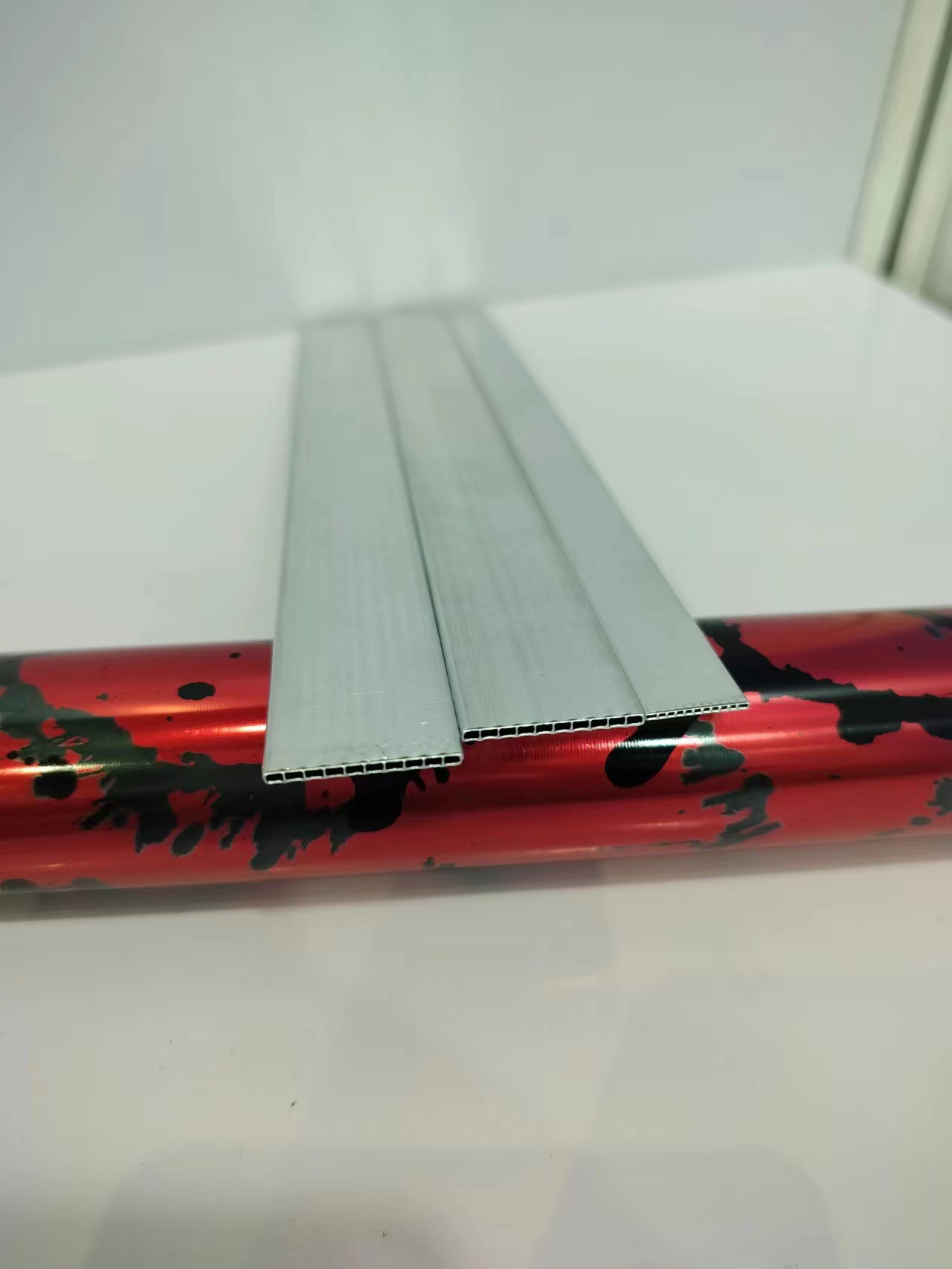
In modern cooling technologies, standard round tubes have been largely replaced by flat, microchannel designs to maximize surface area. Manufacturing a precision multi-port extrusion tube requires an alloy that can be pushed through highly complex steel dies. 3003 aluminum possesses the exact rheological properties needed to flow through these dies without tearing the ultra-thin internal walls. For instance, high-quality 3003 microchannel tubes typically feature wall thicknesses as low as 0.12mm to 0.15mm while supporting burst pressures exceeding 10 MPa. This ensures robust performance in automotive condenser and evaporator units.
Aluminum Side Bars for Mixer Tubes
Beyond standard cooling, specialized industrial fluid management systems rely heavily on this metal's structural stability. An aluminum side bar for mixer tube assemblies must withstand constant vibratory stress and exposure to various chemical fluids. The 3003 alloy provides the necessary rigidity to hold mixing manifolds together. Typical industrial side bars utilize 3003-H112 or O temper. This offers excellent clad brazing compatibility at temperatures around 600 degrees Celsius, ensuring flawless, leak-free integration with the main heat exchanger cores.
Because 3003 is non-heat-treatable, its final mechanical properties are dictated by its temper. Engineers must match the temper to the specific manufacturing process to avoid material failure during production.
O Temper (Annealed): This is the softest state of the alloy. Choose this temper if your manufacturing process involves severe deep-drawing, metal spinning, or sharp bending radii.
H14 Temper (Half-Hard): Strain-hardened to a medium degree of strength. This provides a versatile balance, allowing for moderate bending while maintaining sufficient structural rigidity for exterior paneling or brackets.
H18 Temper (Full-Hard): Heavily cold-worked to its maximum commercial strength. Specify H18 for flat structural components or rigid channels where no further bending is required.
To serve diverse industrial supply chains, 3003 aluminum is milled and supplied in multiple formats. High-volume stamping operations typically procure 3003 in continuous master coils. Due to its excellent flow characteristics, it is also frequently supplied as custom extruded profiles. This allows engineers to design highly specific cross-sectional shapes tailored to proprietary fluid dynamics.
Theoretical properties only translate to real-world performance if the manufacturing process is strictly controlled. Partnering with a manufacturer that understands the metallurgical nuances of 3003 is critical. Poor extrusion practices can lead to microscopic tears in thin-walled tubes, drastically lowering burst pressure. Similarly, if the alloy contains trace impurities beyond standard limits, it can disrupt capillary action during brazing. This leads to porous joints and catastrophic fluid leaks in the field.
Industrial applications rarely rely on off-the-shelf dimensions. Procurement managers must prioritize suppliers capable of delivering tight dimensional tolerances for specialized parts. A manufacturer with deep expertise will not only provide the raw material but will also offer engineering support to optimize the extrusion profile for manufacturability and long-term performance.
Manganese is the metallurgical catalyst that elevates pure aluminum into a highly capable industrial material. By providing an unbeatable triad of enhanced strength, superior formability, and robust corrosion resistance, 3003 bridges the gap between soft conductive metals and rigid structural materials.
Whether you are designing a high-efficiency cooling grid for an electric vehicle or sourcing materials for complex industrial extrusions, this alloy remains the most reliable choice. It delivers consistent, commercial-grade performance without exceeding strict project budgets.
To ensure the success of your next thermal management or structural project, explore the extensive capabilities at Alumag Aluminum. Review our custom catalogs for precision cooling tubes, heat exchangers, and heavy-duty side bars. Contact our engineering team today to discuss your specific dimensional requirements and secure a detailed quote tailored to your production lines.
No. Like all aluminum alloys, the 3000 series is fundamentally non-magnetic. This specific property makes 3003 aluminum safe for use in high-voltage electronic enclosures, sensitive medical equipment, and advanced navigation systems where magnetic interference must be strictly avoided.
No, 3003 is strictly classified as a non-heat-treatable alloy. It cannot be hardened or strengthened through thermal cycling. Instead, it achieves its specific strength profiles through the initial addition of manganese and subsequent cold working processes, such as rolling or drawing.
3003 offers a highly specific combination of empirical traits perfect for thermal management. It delivers high thermal conductivity for rapid heat transfer and excellent brazing characteristics for creating leak-proof joints. Its high ductility allows it to be extruded into thin, complex internal geometries without cracking under immense manufacturing pressure.
The primary difference lies in their alloying elements and heat-treatability. 3003 uses manganese and is non-heat-treatable, excelling in formability and brazing for fluid routing. 6061 utilizes magnesium and silicon, making it heat-treatable to achieve much higher structural strength. 6061 is preferred for load-bearing structural frames, whereas 3003 is the industry standard for thermal management and sheet metal forming.
3003 aluminum maintains excellent mechanical properties at sub-zero temperatures and performs reliably in continuous operating environments up to 200 degrees Celsius. However, prolonged exposure to temperatures above 200 degrees Celsius will cause the cold-worked alloy to gradually anneal, resulting in a loss of tensile strength over time.