Tel:+86-512-53640771-125 E-mail: export@alumag.com.cn
- All
- Product Name
- Product Keyword
- Product Model
- Product Summary
- Product Description
- Multi Field Search

Views: 0 Author: Site Editor Publish Time: 2026-07-26 Origin: Site


The long-term performance and manufacturability of any custom extrusion project are determined before the die is cut, resting entirely on the specification of the correct aluminum alloy. Specifying an incompatible alloy leads to critical failures. You might see premature structural fatigue in the field, unacceptable surface finishes after anodizing, excessive die wear on the press, or prohibitive post-machining costs. Many engineering teams default to familiar materials without evaluating how the metal flows through a specific die geometry. This guide provides a technical evaluation framework for engineers and procurement teams to compare aluminum alloys, balance mechanical properties against extrudability, and select the optimal material for specific application requirements. We will break down the exact mechanical thresholds, finishing behaviors, and machining characteristics you must evaluate before finalizing your CAD drawings.
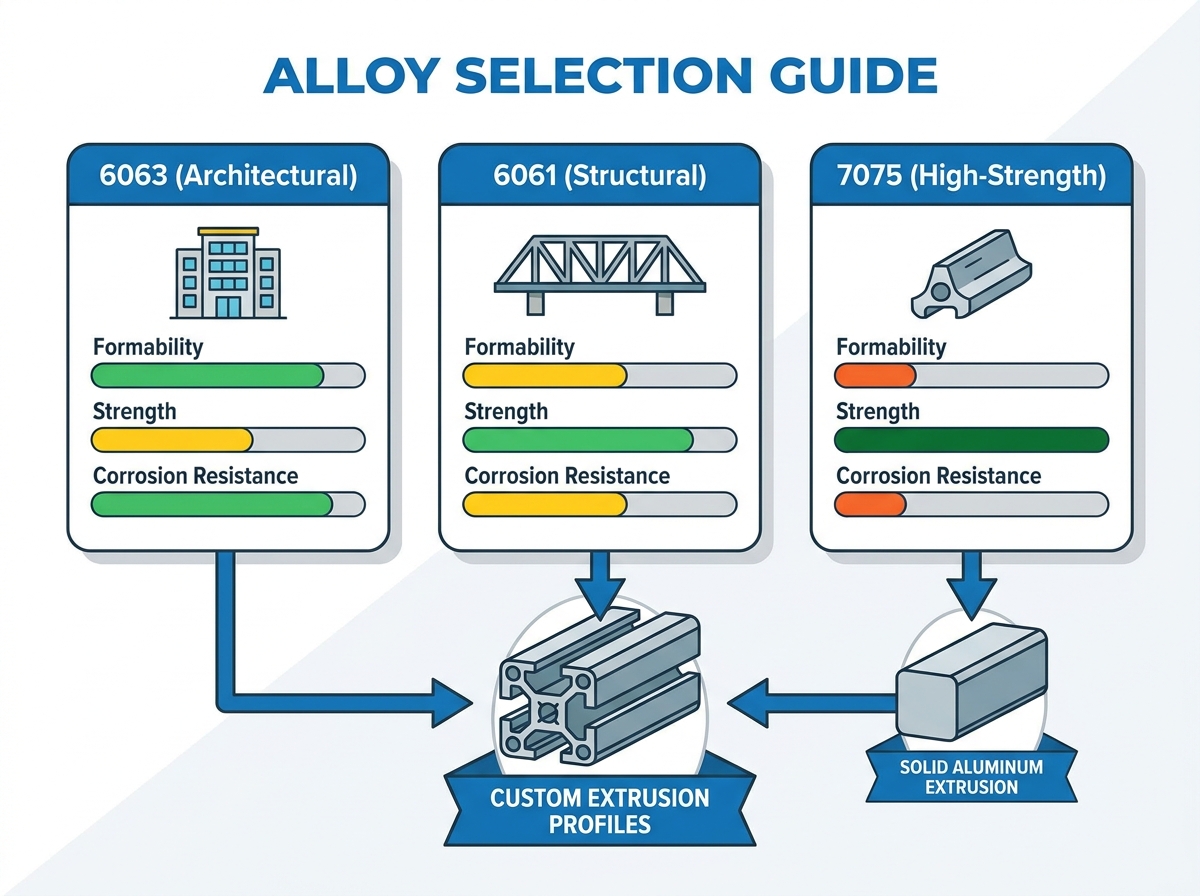
6063 is the architectural standard: It offers the highest extrudability and superior surface finish, making it the default for complex, aesthetic, and intricate custom shapes.
6061 is the structural workhorse: It provides significantly higher yield strength for load-bearing applications, though it requires trade-offs in extrusion speed and anodizing response.
Temper is as critical as the alloy: The base chemical composition must be paired with the correct heat treatment (e.g., T5, T6, T651) to achieve the required final mechanical properties and dimensional stability during post-machining.
Profile complexity dictates alloy limits: Highly intricate hollows require highly formable alloys, whereas a solid aluminum extrusion can accommodate stiffer, higher-strength alloys with less risk of die failure.
Selecting the right material begins with defining the baseline mechanical requirements for your specific application. You must establish the necessary yield strength, ultimate tensile strength, and elongation percentages based on expected load-bearing conditions. A component supporting static weight requires different material properties than one subjected to constant vibration or repeated impacts. You must establish whether the profile will undergo dynamic stress, which demands high fatigue resistance, or static loading, where sheer yield strength is the primary concern.
Alloy behavior varies significantly across common structural shapes. Standard square tubes distribute loads differently than structural U-channels or complex hollows. When designing aluminum extrusion profiles, you have to account for how the alloy's grain structure aligns during the extrusion process. High-strength alloys might perform exceptionally well in a thick-walled rectangular tube but could fail or crack when forced through a die designed for a thin-walled, multi-void hollow shape. We see dies fail constantly when engineers specify an alloy that is too stiff for the intended geometry.
Surface finish requirements heavily influence alloy selection. Evaluate the necessity for post-extrusion surface treatments such as clear anodizing, color anodizing, or powder coating early in the design phase. The chemical composition of the alloy directly dictates how it will react to these finishing processes.
Alloys with higher silicon or magnesium content react differently to anodizing baths. High silicon levels can cause the metal to turn gray or dark during clear anodizing, impacting color consistency and surface luster. If your project demands a bright, uniform, and highly reflective surface, you must specify an alloy formulated specifically to respond well to chemical brightening and anodizing processes. Powder coating is more forgiving regarding the base metal appearance, but the alloy must still withstand the oven curing temperatures without losing its mechanical temper.
Most extrusions require some form of downstream processing before final assembly. Assess the need for CNC machining, drilling, tapping, or bending. Softer alloys might gum up machining tools, wrapping long, stringy chips around end mills and slowing down production. Harder alloys produce clean, crisp chips that evacuate easily, but they require more robust cutting equipment and reduce tool life.
Identify all welding requirements during the specification phase. Some high-strength aluminum alloys lose significant structural integrity at the heat-affected zone during welding. If the assembly must be welded, you need an alloy that retains its mechanical properties post-weld or one that can be effectively heat-treated after the welding process to restore its strength. Using the wrong filler wire with an incompatible base alloy will result in immediate cracking along the weld seam.
The 6063 alloy is a magnesium and silicon blend optimized for maximum extrudability. It flows easily through complex dies, allowing manufacturers to produce intricate shapes with extremely tight tolerances and thin walls. This material represents the industry standard for most general-purpose applications.
Its primary strengths include an exceptional surface finish, high natural corrosion resistance, and the ability to form very thin walls and complex hollow profiles without tearing. Because it responds beautifully to anodizing, 6063 is the best choice for window frames, heat sinks, trim, and aesthetic architectural components where visual appeal is just as important as structural form. When you push 6063 through a press, the metal moves smoothly, reducing friction and extending the life of the steel die.
When an application demands higher load-bearing capabilities, 6061 is the go-to material. It features higher magnesium and silicon content than 6063, along with strategic additions of copper and chromium. This specific chemical makeup yields a much stronger final product.
The strengths of 6061 include a high strength-to-weight ratio, excellent weldability, and robust structural integrity under heavy loads. However, these benefits come with necessary trade-offs. 6061 has lower extrudability, meaning it requires slower run speeds on the press and causes higher die wear. It also produces a duller, less consistent finish after anodizing compared to 6063. It is best suited for machine frames, structural components, and transport applications where a custom aluminum extrusion profile must prioritize strength over aesthetics.
The 6005 and 6005A alloys bridge the performance gap between 6063 and 6061. Their composition provides a highly effective compromise for engineers who need more strength than 6063 can offer but cannot accommodate the extrusion limitations of 6061.
These alloys offer better extrudability than 6061 while providing higher strength and superior resistance to bending and impact than 6063. They are frequently specified for automotive structural components, transit applications, ladders, and structural profiles requiring complex geometries that would be too difficult to push in 6061. We often recommend 6005A for crash management systems because it absorbs impact energy effectively without shattering.
For projects where appearance is the absolute highest priority, 6463 provides a specialized solution. Its composition is very similar to 6063, but it is manufactured with strictly controlled, ultra-low iron content to avoid any dulling of the finish.
This alloy is specifically formulated to respond to chemical bright-dip anodizing, resulting in a mirror-like finish that mimics chrome or polished stainless steel. It is the best option for premium consumer goods, automotive trim, shower enclosures, and decorative hardware where a flawless, highly reflective surface is mandatory.
Alloy Grade | Typical Yield Strength (ksi) | Extrudability Rating | Primary Field Application |
|---|---|---|---|
6063-T5 | 21 | Excellent | Architectural trim, heat sinks, window frames |
6061-T6 | 35 | Fair | Structural frames, heavy transport, brackets |
6005A-T61 | 31 | Good | Automotive structures, transit, ladders |
6463-T5 | 22 | Excellent | High-luster trim, shower doors, consumer goods |
The 1XXX series consists of alloys with a 99% minimum aluminum purity. Because they lack significant alloying elements like magnesium, silicon, or copper, they exhibit unique behavioral characteristics during the extrusion process.
This series offers maximum formability, exceptional corrosion resistance, and superior thermal and electrical conductivity. However, it completely lacks structural strength. It cannot bear heavy loads and will deform easily under mechanical stress. Therefore, its use cases are strictly limited to electrical busbars, specialized heat transfer components, and chemical processing equipment where conductivity or extreme corrosion resistance outweighs mechanical strength.
These series utilize different primary alloying elements: Manganese (3XXX), Silicon (4XXX), and Magnesium (5XXX). While they are common in sheet metal and cast aluminum applications, they present significant challenges in the extrusion process.
While these series feature excellent raw material formability (3XXX) and superior marine-grade corrosion resistance or weldability (5XXX), they are notoriously difficult to extrude into complex custom profiles. The metal does not flow smoothly through intricate die openings, leading to high scrap rates and frequent die breakage. Their use in extrusion is generally restricted to simple structural tubes, basic U-channels, or solid shapes where specific environmental resistance is absolutely non-negotiable. For example, 5052 is a fantastic sheet metal alloy, but pushing it through an extrusion press requires massive tonnage and yields poor surface results.
Engineers must constantly navigate the inverse relationship between material strength and extrudability. As alloy strength increases, extrusion speed decreases, and die wear accelerates. Pushing a hard alloy through a complex die requires immense pressure, which can warp the die or cause the aluminum to tear as it exits the press.
You need a framework for deciding when to over-engineer a profile's wall thickness in a weaker, highly extrudable alloy versus specifying a high-strength, hard-to-extrude alloy. Often, increasing the wall thickness of a 6063 profile slightly will achieve the required structural integrity while keeping tooling costs low and production speeds high. Conversely, if weight reduction is critical, you must accept the higher manufacturing costs associated with extruding a thinner 6061 profile.
Follow this process when evaluating the trade-off:
Calculate the maximum expected load on the specific profile section.
Determine the minimum wall thickness required if using a standard 6063 alloy.
Evaluate if that wall thickness fits within the physical envelope of your assembly.
If the envelope is too small, upgrade the material to 6005A or 6061 and accept the higher tooling costs.
Adjust the extrusion die design to account for the slower flow rate of the harder alloy.
For heat sinks and electrical applications, thermal and electrical conductivity dictate the alloy choice. When comparing the thermal dissipation properties of 6063 against a 1060 pure aluminum alloy for heat sink applications, 1060 offers better raw thermal transfer. However, 6063 allows for much thinner, taller, and more densely packed cooling fins due to its superior extrudability, often resulting in a more efficient overall heat sink design.
Evaluate electrical conductivity requirements carefully for custom profiles used in power distribution. While pure aluminum offers the best conductivity, it may require bulky support structures. Sometimes a slightly less conductive 6XXX series alloy provides the necessary rigidity to act as both a structural support and a conductor, eliminating the need for secondary steel framing.
Assess the operating environment meticulously. Profiles deployed in marine, heavy chemical, or high-humidity environments face rapid degradation if the wrong material is specified.
Determine if the inherent corrosion resistance of the bare alloy is sufficient or if protective anodizing is required. The 6063 alloy offers excellent natural corrosion resistance and anodizes perfectly, making it ideal for outdoor architectural use. If you require the strength of 6061 in a corrosive environment, you must factor in the dimensional changes of applying a thick hard-coat anodize or powder coat to protect the underlying metal. Galvanic corrosion is another threat; if your aluminum profile will bolt directly to steel, you must specify an isolating barrier or a highly resistant alloy to prevent the aluminum from acting as a sacrificial anode.
Specifying standard alloys like 6061 and 6063 drastically reduces raw material costs and accelerates production schedules. Extruders keep massive inventories of these billets on hand, allowing them to schedule production runs quickly. The supply chain for these materials is robust, global, and highly competitive.
Conversely, requesting niche alloys for extrusion introduces severe supply chain risks. Alloys like 7075 or 5052 require custom billet casting. This triggers massive minimum order quantity requirements and extends lead times by months. Unless your application absolutely demands the specific properties of an aerospace-grade or marine-grade alloy, stick to the 6XXX series to maintain project velocity.
The geometry of your design directly impacts tooling costs and alloy viability. Intricate hollows, multiple internal voids, and varying wall thicknesses drive up die costs because the toolmaker must design complex mandrels to support the internal shapes during extrusion. These porthole dies are expensive to machine and prone to failure if pushed too hard.
Contrast the tooling costs of a solid aluminum extrusion with those of a complex multi-hollow configuration. Solid profiles require flat dies, which are significantly cheaper to cut and maintain. They can also handle stiffer alloys without breaking. Choosing a highly formable alloy like 6063 for complex hollows minimizes die breakage, reduces friction, and lowers long-term tooling replacement costs over the lifecycle of the product.
High-strength alloys are prone to distortion, twisting, or warping during the quenching process. As the metal exits the press at high temperatures and is rapidly cooled by air or water, uneven thermal contraction can pull the profile out of tolerance. 6061 requires a much more aggressive water quench than 6063 to hit its mechanical properties, which inherently causes more distortion.
To mitigate this risk, match the alloy's formability to the profile's complexity. Utilize uniform wall thicknesses in your CAD design to ensure even cooling across the entire cross-section. Avoid massive transitions from thick solid sections to paper-thin fins, as these areas will cool at vastly different rates, inducing severe internal stresses and warping.
Specifying an alloy without the correct temper results in a part that fails under load or deforms during CNC machining. The temper designation dictates the heat treatment process used to lock in the material's final mechanical properties.
Temper Designation | Heat Treatment Process | Practical Field Result |
|---|---|---|
T4 | Solution heat-treated and naturally aged. | Leaves the metal workable for severe secondary bending or forming operations. |
T5 | Cooled from an elevated temperature shaping process and artificially aged. | Standard strength and good dimensional stability. Typical for 6063 architectural profiles. |
T6 | Solution heat-treated and artificially aged. | Maximizes yield strength for load-bearing parts. Standard for structural 6061 components. |
T651 | Solution heat-treated, stress-relieved by stretching, and artificially aged. | Prevents twisting, warping, and dimensional shifting during heavy post-extrusion CNC machining. |
Run a design-for-manufacturability review with your extrusion partner to validate alloy flow characteristics against your specific die geometry.
Specify the exact temper designation on all CAD drawings to guarantee the final mechanical properties match your load requirements.
Standardize wall thicknesses across your profile design to mitigate uneven cooling and warping during the quenching process.
Request a short prototype run to test the alloy's response to your planned post-extrusion CNC machining and anodizing steps.
A: The 6063 alloy is the most commonly used material for general and architectural profiles due to its excellent surface finish and extrudability. For structural applications requiring higher load-bearing capacity, 6061 is the standard choice.
A: 6061 offers significantly higher yield strength, making it ideal for heavy structural frameworks. 6063 provides better extrudability, faster production speeds, tighter tolerances for complex hollows, and a superior, more consistent finish when anodized.
A: Solid profiles are less restricted by extrudability limitations than complex hollows. Therefore, 6061, 6005A, or 6061-T651 are excellent choices for high-strength solid bars, heavy U-channels, or structural supports that require maximum rigidity.
A: While 7075 aluminum can be extruded, it is extremely difficult. It requires immense press pressure, causes rapid die wear, and is limited to very simple, thick-walled solid shapes. It also carries high minimum order quantities and long lead times.
A: The temper determines the heat treatment process the aluminum undergoes after extrusion. This process aligns the grain structure and locks in the final mechanical properties, dictating the ultimate yield strength, dimensional stability, and machinability of the profile.