Tel:+86-512-53640771-125 E-mail: export@alumag.com.cn
- All
- Product Name
- Product Keyword
- Product Model
- Product Summary
- Product Description
- Multi Field Search

Views: 0 Author: Site Editor Publish Time: 2026-08-02 Origin: Site


Achieving maximum specific tensile strength in aerospace and defense components requires precise thermal processing. Complex part geometries introduce severe metallurgical variables that engineers must manage on the shop floor. Variations in section thickness create thermal gradients during both heating and quenching. These gradients lead to uneven heating and cooling rates across the component. This results in inconsistent precipitation hardening, unacceptable dimensional distortion, and residual stress. It also causes increased scrap rates during the final machining of a high strength aluminum extrusion or complex machined component.
For engineers and procurement teams specifying materials for high-stress applications, understanding the relationship between cross-sectional thickness and heat treatment response is critical. This guide breaks down how to evaluate thickness limitations, mitigate distortion risks, and ensure uniform mechanical properties when sourcing advanced 7000 series aluminum.
Thermal Gradients Dictate Yield: Thin sections heat and cool rapidly, while thicker core sections lag during solution heat treatment (SHT) and quenching, creating internal stresses that can compromise the structural integrity of the final component.
Quench Sensitivity is High: 7000 series aluminum alloys require rapid quenching from solution heat treatment temperatures to maintain alloying elements in solid solution; thick sections naturally resist this rapid core cooling.
Geometry Influences Material Selection: The choice between a solid 7075 aluminum rod, a custom high strength aluminum extrusion, or a forged block must account for the maximum achievable through-thickness hardness and elongation.
Advanced Aging Cycles are Mandatory for Thick Parts: Utilizing specialized tempers (like T73 or Retrogression and Re-Aging - RRA) is necessary to balance strength with Stress Corrosion Cracking (SCC) resistance, though thermal lag in thick sections complicates these precise windows.
Mechanical Stress Relief Supplementation: Thermally induced stresses in thick profiles must often be mitigated by post-quench stretching or cold-working (Tx51 tempers) to prevent massive distortion during final machining.
Solution heat treatment requires a specific temperature window to dissolve zinc, magnesium, and copper into a solid solution. This range typically falls between 850°F and 1050°F (454°C to 566°C). For alloys like 7075, 495°C (923°F) serves as the common benchmark. Industrial furnaces must maintain strict temperature uniformity, usually within ±3°C across the entire working zone. This precision prevents localized eutectic melting or incomplete dissolution of alloying elements. Operators rely on load thermocouples physically attached to the thickest and thinnest sections of the parts to monitor real-time metal temperatures rather than just ambient furnace air.
During the heating gradient phase, section thickness dictates the thermal response. Thin sections reach SHT temperatures rapidly. This speed risks grain coarsening if the soak time is excessive, which degrades fatigue life. Thicker sections lag significantly behind the surface temperature. If soak times are miscalculated based on the surface rather than the core, the center of the material risks incomplete solutionization. This leaves vital alloying elements out of the solid solution, permanently capping the maximum achievable strength regardless of subsequent aging processes.
The transition from the furnace to the quench tank must be immediate. Quench delay limits are strictly enforced, often requiring transfer times under 10 seconds for thin sections, to prevent premature precipitation of alloying elements along grain boundaries. Once submerged, the cooling rate determines the supersaturated solid solution (SSSS) state prior to aging. A rapid, uniform quench locks the dissolved elements in place. This creates the necessary microstructural foundation for subsequent strengthening. Agitation in the quench tank breaks up the vapor blanket that forms around the hot metal, ensuring the liquid quenchant maintains direct contact with the aluminum surface for maximum heat extraction.
Controlled reheating precipitates strengthening phases within the metal matrix. These are primarily the η' and η phases. Uniform aging requires a uniformly solutionized and quenched microstructure. If the quench rate varies due to thickness differences, the resulting precipitation will be uneven. Thermal gradients directly compromise the final strength of the component. Shop floor operators must carefully program aging ovens with stepped cycles to control the size and distribution of these precipitates. A poorly quenched thick section will over-age rapidly in the core, dropping yield strength well below aerospace minimums.
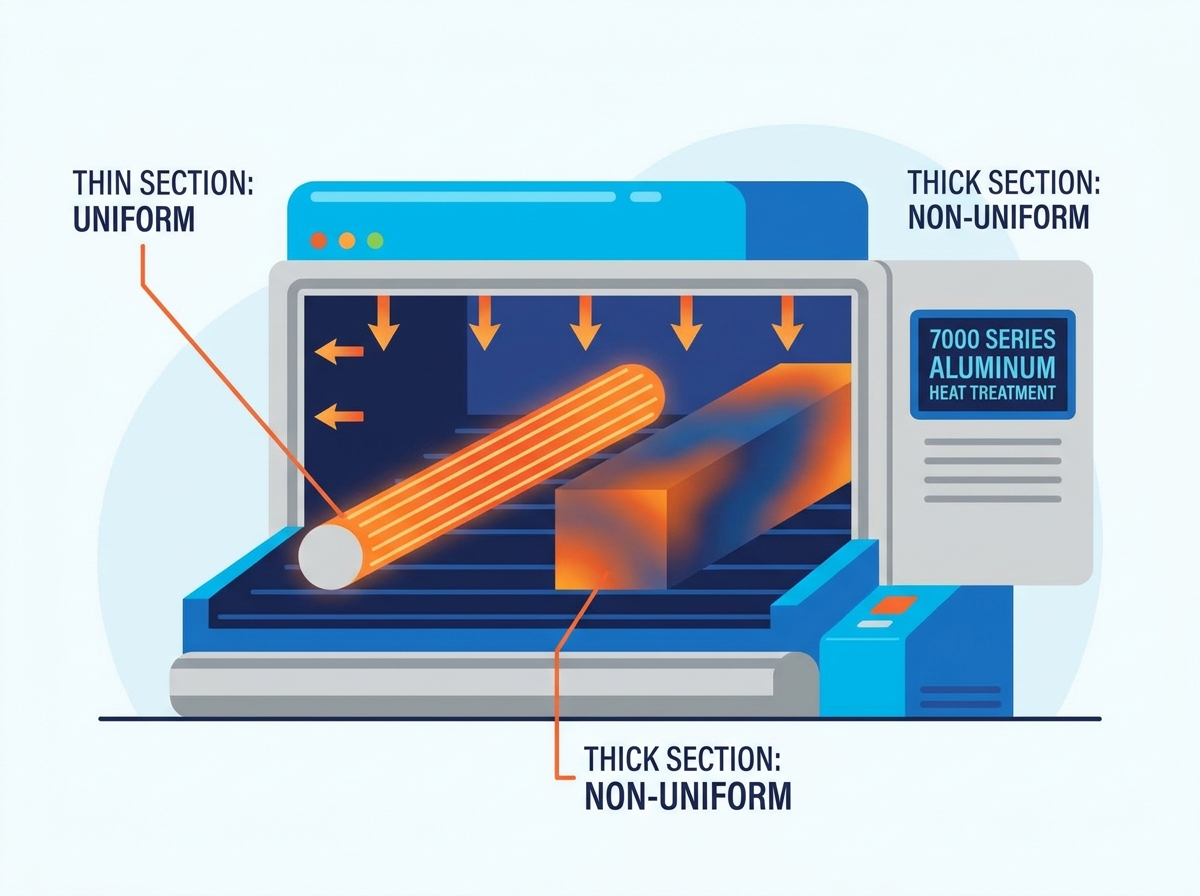
The physics of heat transfer rely heavily on surface area-to-volume ratios. Thin webs possess high ratios, allowing rapid heat dissipation into the quenching medium. Thick hubs have low ratios, restricting heat flow from the center of the mass to the surface. Thick sections act as massive thermal sinks during quenching. The core cools at a mere fraction of the surface rate. This differential creates a severe thermal gradient across the component cross-section. Engineers must calculate these gradients to predict where the material will fall short of required mechanical properties.
Cooling Rate Discrepancies Based on Section Thickness | |||
Section Thickness (Inches) | Surface Cooling Rate (°F/sec) | Core Cooling Rate (°F/sec) | Expected Core Hardness Drop |
|---|---|---|---|
0.5 | 300+ | 250 | Minimal |
2.0 | 250 | 100 | Moderate (5-10%) |
4.0 | 150 | 40 | Severe (15-25%) |
6.0+ | 100 | <20 | Unacceptable for structural use |
A slow core quench in thick sections causes heterogeneous precipitation at grain boundaries. Elements fall out of solution prematurely instead of remaining trapped in the SSSS state. This microstructural discrepancy leads to a significant drop in core tensile strength. Yield strength and ultimate elongation in the core also fall far below the properties of the rapidly cooled surface. Destructive testing often reveals a soft core that fails to meet the minimum requirements of the material specification, forcing engineers to redesign the part or change the manufacturing sequence.
Distortion mechanics are driven by uneven contraction. Thin sections contract faster than adjacent thick sections during the quench. This induces severe tensile and compressive stresses within the material. The cost implications of this distortion are substantial. Operations face post-quench straightening requirements, increased machining allowances, and higher rates of rejected parts. When a machinist cuts into a part with high residual stress, the material moves, warping out of tolerance before the final pass is even complete.
Identify the thickest cross-section of the raw material.
Calculate the expected core cooling rate based on the quenchant type.
Determine the required machining allowance to remove the distorted surface layer.
Specify a stress-relieved temper to mitigate movement during final machining.
Complex extruded profiles often feature highly asymmetric wall thicknesses. Managing these variations during heat treatment is challenging. Press-quenching involves direct extrusion quenching at the press using water sprays or forced air. This method has limitations for parts with massive thickness variations, as the thin flanges cool instantly while the thick structural nodes retain heat. Dedicated offline solution heat treatment is often required for critical structural extrusions to ensure proper solutionization and controlled quenching in a vertical drop furnace, which minimizes distortion caused by gravity at elevated temperatures.
Achieving uniform T6 properties in a solid 7075 aluminum rod has practical diameter limits. As the diameter increases, the core cooling rate decreases. Engineers must specify rod diameter based on final machined part dimensions. This prevents exposing soft cores during final machining. Stretching and cold work produce T6511 or T73511 tempers. These processes supplement heat treatment by mechanically redistributing and relieving residual quenching stresses in round bar and rod stock. If a part requires a 4-inch diameter finished dimension, starting with a 6-inch rod and machining away the hardened surface will leave a substandard core exposed to operational loads.
Heat treating massive blocks and forgings presents extreme challenges. The immense volume guarantees a slow core quench. Specialized water-glycol quenchants are often necessary to manage the cooling rate and prevent cracking. Stress-relief stretching, resulting in Tx51 tempers, is mandatory to make these thick plates dimensionally stable for subsequent machining operations. Heavy plate stretchers grab the ends of the material and pull it past its yield point, permanently elongating it by 1.5% to 3%. This mechanical yielding erases the chaotic residual stresses left behind by the quench tank.
Engineers face an inverse relationship between minimizing distortion and maximizing strength. Slower quenching reduces thermal gradients and subsequent distortion. However, a slow quench allows alloying elements to precipitate prematurely. This significantly reduces the final yield strength and elongation. Balancing these competing factors requires precise control over the quenching medium and process parameters. You cannot have maximum T6 strength and zero distortion in a complex, variable-thickness part without extensive post-quench mechanical intervention.
Residual stresses from uneven quenching accelerate SCC in corrosive environments. Variable thicknesses exacerbate these internal stresses, creating localized areas of high tensile stress at the surface. Over-aging to T7x tempers is often necessary to stabilize grain boundaries and improve SCC resistance. Engineers must acknowledge that this over-aging process typically results in a 10-15% reduction in peak strength compared to the T6 condition. The T73 temper involves a two-step aging process that coarsens the precipitates at the grain boundaries, breaking up the continuous network that allows corrosion to propagate.
RRA is a specialized heat treatment designed to maintain T6 strength while achieving T73 SCC resistance. RRA relies on a transient phase where precipitate particles grow and coarsen. Applying RRA to very thick sections has physical limitations. The core thermal lag makes it nearly impossible to control the highly sensitive, narrow time-temperature window required for effective retrogression. If the core spends too much time at the retrogression temperature while waiting for the surface to catch up, it will over-age completely, ruining the mechanical properties.
Rough-machining parts to near-net shape before heat treatment is a highly effective strategy. This reduces the maximum section thickness and improves quench uniformity. By removing excess bulk material, the core is brought closer to the quenching medium. However, bypassing rough-machining poses significant risks. Final machining of a fully heat-treated, thick component releases trapped residual stresses. This release often causes severe distortion, rendering the part out of tolerance. Rough machining leaves a small envelope of material, usually 0.100 to 0.250 inches, to be removed after the metal has been fully heat-treated and stabilized.
Quenchant selection dictates the cooling rate. Cold water provides the fastest quench but causes the highest distortion. Hot water slows the quench slightly. Polyalkylene glycol (PAG) polymer quenchants offer a tailored approach. Polymer quenchants modify the vapor blanket phase. This reduces the cooling rate differential between thick and thin sections, minimizing distortion while maintaining acceptable strength. The concentration of the polymer can be adjusted; a higher concentration slows the quench further, providing a tunable variable for heat treaters dealing with difficult geometries.
Mechanical stress relief is a critical step for thick materials. Specifying stretched tempers like T651 or T7351 is necessary for thick plates, rods, and extrusions. This controlled stretching mechanically relieves up to 90% of quench-induced residual stresses. Performing this step before final machining ensures the material remains dimensionally stable during aggressive material removal. For forged blocks where stretching is impossible, cold compression (Tx52 temper) is used, where the block is squeezed in a massive hydraulic press to achieve the same stress-relieving plastic deformation.
Engineers must demand specific documentation from heat treatment partners. Required data includes cooling curve analysis and furnace thermal mapping per AMS2750 standards. Destructive core testing data is also essential to verify through-thickness properties. Evaluating a supplier's capability to manage thermal gradients ensures the final components meet strict aerospace and defense specifications. A supplier must prove they have the agitation capacity in their quench tanks to handle the specific mass of the load being processed.
Review current component designs to identify and minimize extreme thickness variations before finalizing blueprints.
Specify rough machining to near-net shape prior to solution heat treatment to improve core quench rates.
Require suppliers to utilize polymer quenchants and mechanical stress-relieving equipment for parts prone to distortion.
Demand destructive core testing data from heat treatment partners to verify through-thickness mechanical properties.
Consult with a metallurgist to select the appropriate over-aged temper (like T73) if the operating environment poses a high risk of stress corrosion cracking.
A: While surface hardness can be achieved on large blocks, uniform through-thickness mechanical properties typically begin to degrade in sections thicker than 3 to 4 inches (75-100mm) due to slower core quench rates.
A: Thin sections cool and contract much faster than adjacent thick sections. This thermal gradient creates internal mechanical stresses that exceed the material's yield strength at elevated temperatures, causing warping or distortion.
A: Yes. Polymer quenchants reduce the initial shock of the quench by modifying the vapor blanket phase. This allows for a more uniform cooling rate across varying thicknesses compared to cold water, thereby reducing residual stress and distortion.
A: Thick sections are prone to slower quench rates, which causes continuous grain boundary precipitation. Combined with high residual tensile stresses from uneven cooling, this microstructure makes thick sections highly susceptible to SCC in corrosive environments.
A: The Tx51 temper indicates that the material has been stress-relieved by stretching after quenching. This mechanical process redistributes and eliminates internal residual stresses, preventing severe distortion during subsequent machining operations.