Tel:+86-512-53640771-125 E-mail: export@alumag.com.cn
- All
- Product Name
- Product Keyword
- Product Model
- Product Summary
- Product Description
- Multi Field Search

Views: 0 Author: Site Editor Publish Time: 2026-07-25 Origin: Site


In aerospace and high-stress structural engineering, specifying the correct alloy is only half the equation; material failure frequently stems from selecting the wrong temper for the environmental operating conditions. Engineers must constantly navigate the strict trade-off between maximizing tensile strength and mitigating catastrophic failures caused by Stress Corrosion Cracking (SCC) and exfoliation corrosion in performance alloys like 7075 and 7050. This guide breaks down the metallurgical realities of T6, T73, and T74 tempers, providing a technical framework to evaluate how heat treatment, aging processes, and quench sensitivity dictate the performance, longevity, and reliability of 7000 series aluminum components. We will examine the exact mechanisms that drive grain boundary precipitation and how specific thermal cycles alter the anodic behavior of the metal. You will learn how to match part geometry, from thin extrusions to massive forgings, with the appropriate overaged state to prevent premature structural fatigue in the field.
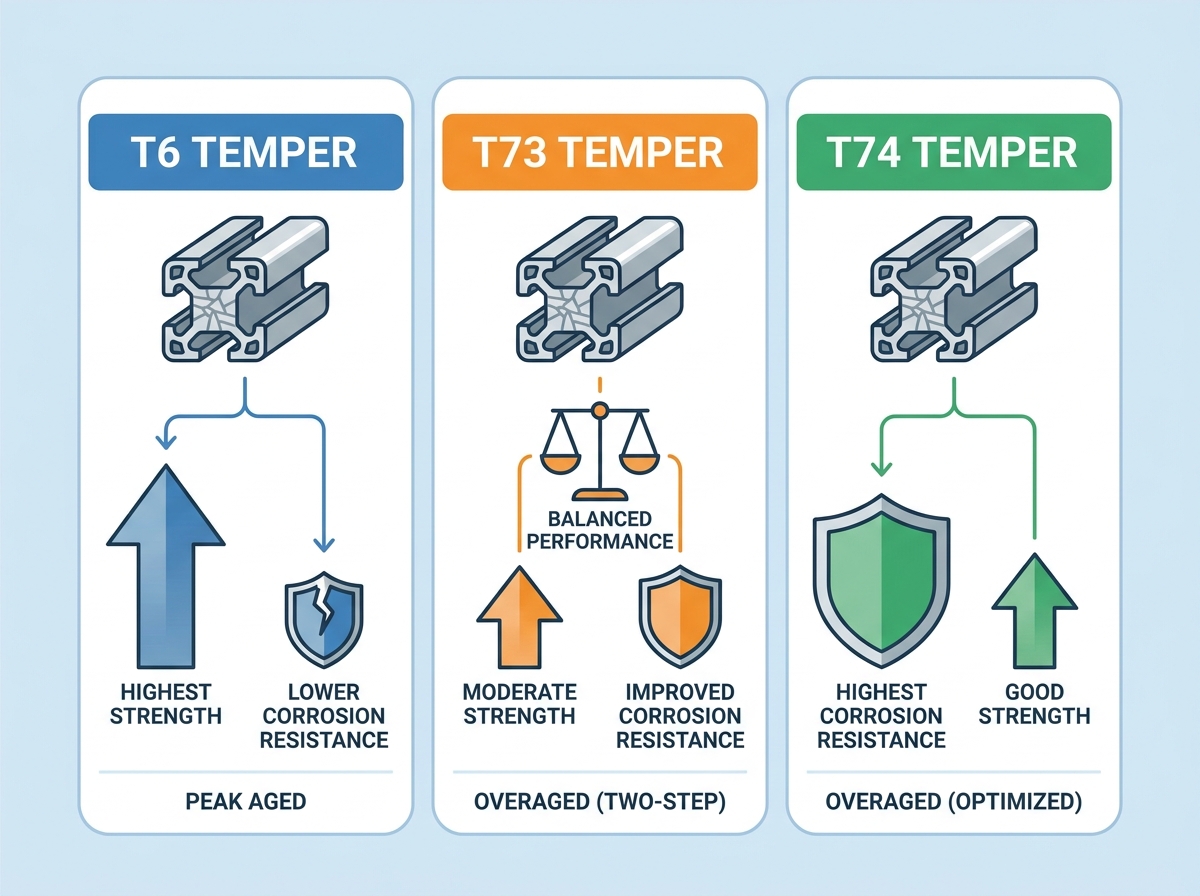
T6 Temper delivers the absolute peak yield and tensile strength but leaves the material highly susceptible to SCC in corrosive environments.
T73 Temper utilizes a severe overaging process to maximize SCC and exfoliation resistance, sacrificing approximately 10–15% of the material's peak strength.
T74 Temper (formerly T736) acts as an intermediate solution, offering better corrosion resistance than T6 while retaining higher strength and fracture toughness thresholds than T73.
Alloy Chemistry Nuances: While 7075 is the industry standard, 7050 aluminum was specifically developed to combine with T74 to reduce quench sensitivity in thick sections.
Form Factor Matters: The efficacy of a temper is heavily influenced by part geometry, soak times, and quenching rates, meaning a thick plate will behave differently than a 7075 aluminum rod or a thin-walled extrusion.
Verification: Non-destructive electrical conductivity testing (% IACS) paired with Rockwell hardness testing is critical to verify that overaging has successfully occurred.
The foundation of any high-performance structural component begins with its chemical matrix. The primary alloying elements in this category are zinc, magnesium, and copper. Zinc and magnesium combine to form the primary strengthening precipitates, while copper enhances overall strength and improves resistance to stress corrosion. Alloy 7075 remains the legacy standard for aerospace applications, typically containing around 5.6% zinc, 2.5% magnesium, and 1.6% copper. However, alloy 7050 introduces a specific modification by replacing the chromium found in 7075 (0.18-0.28%) with zirconium (0.08-0.15%). Zirconium acts as a potent grain refiner and drastically reduces quench sensitivity. This chemical shift allows 7050 to maintain consistent mechanical properties throughout heavy-section forgings and thick plates where rapid, uniform cooling is physically impossible.
Transforming a raw billet into a structural powerhouse requires precise thermal management. The process begins with solution heat treating, where the metal is heated to approximately 870°F to 900°F (465°C to 482°C) to dissolve soluble alloying elements into a solid solution. Rapid quenching follows immediately. Aerospace specifications mandate a quench delay of no more than 10 to 15 seconds. Plunging the hot metal into water or polymer quenchants traps these elements in a supersaturated state. Finally, artificial aging applies controlled heat over specific time intervals, usually between 250°F and 350°F. This step forces the dissolved elements to precipitate out of the solid solution, forming microscopic structures that lock the crystal lattice in place and provide the metal's characteristic strength.
Metallurgy always demands a compromise. The core conflict in these alloys revolves around precipitate size and distribution along the grain boundaries. When precipitates are small and continuously linked along the grain boundary, they create an optimal barrier to dislocation movement, yielding maximum mechanical strength. Unfortunately, this continuous network also creates a highly reactive anodic path. The precipitates (primarily MgZn2) are anodic relative to the surrounding aluminum matrix. When exposed to corrosive environments under sustained tensile stress, this path facilitates rapid intergranular corrosion and SCC. Breaking up this continuous network improves corrosion resistance but inherently reduces the material's ability to resist mechanical deformation.
Engineers cannot visually inspect microscopic precipitates on the shop floor, so they rely on electrical conductivity as a proxy for the aging state. Measured in % IACS (International Annealed Copper Standard), conductivity changes as the internal structure evolves. In a supersaturated solid solution, dissolved elements scatter electrons, keeping conductivity low. As the alloy undergoes artificial aging and elements precipitate out of the solid solution, electron flow improves. Transitioning from a peak-strength state to an overaged state predictably raises the electrical conductivity. This measurable shift provides a reliable, non-destructive method to verify heat treatment success.
Temper Designation | Typical Conductivity (% IACS) | Microstructural State | Primary Verification Goal |
|---|---|---|---|
T6 | 31.0 - 33.0 | Peak Aged (Fine Precipitates) | Confirm maximum strength achieved. |
T74 | 38.0 - 41.0 | Intermediate Overaged | Confirm partial disruption of grain boundaries. |
T73 | 39.0 - 43.0 | Fully Overaged (Coarse Precipitates) | Confirm maximum SCC resistance achieved. |
T76 | 36.0 - 38.0 | Lightly Overaged | Confirm exfoliation resistance achieved. |
The T6 temper represents the pinnacle of mechanical strength for these alloys. Achieving this state requires a single-stage artificial aging process. After solution heat treatment and rapid quenching, the material is held at a relatively low aging temperature (around 250°F) for an extended period, typically 24 hours. This specific thermal cycle promotes the dense formation of Guinier-Preston (GP) zones and finely dispersed eta-prime precipitates. These microscopic structures create maximum strain within the crystal lattice, effectively blocking dislocation movement and hardening the metal to its absolute peak.
When structural loads dictate design, T6 is the default baseline. Standard 7075-T6 routinely exhibits ultimate tensile strengths exceeding 83 ksi (570 MPa) and yield strengths above 73 ksi (500 MPa). These metrics make it one of the strongest commercially available aluminum variants. However, this extreme strength comes at a cost. The fracture toughness of T6 is notably lower than its overaged counterparts, often hovering around 20 to 25 ksi-in^1/2. The material tends to be more brittle, meaning it has a reduced capacity to absorb energy and resist crack propagation under sudden impact or cyclic fatigue loading.
The greatest threat to a T6 component is not mechanical overload, but environmental degradation. The single-stage aging process leaves a continuous, closely spaced network of precipitates along the grain boundaries. In the presence of moisture, chlorides, or other corrosive agents, this network acts as a sacrificial anode. If the component simultaneously experiences sustained tensile stress—whether from external loads or internal residual stresses from machining—Stress Corrosion Cracking can initiate. SCC propagates rapidly along the grain boundaries, often leading to sudden, catastrophic failure with little to no visible warning. The short transverse (ST) grain direction is particularly vulnerable in this temper.
Given its vulnerability to SCC, T6 is strictly reserved for applications where environmental exposure is tightly controlled or entirely negligible. It excels in internal airframe components, enclosed structural supports, floor beams, and specific high strength aluminum extrusion profiles used in dry, climate-controlled environments. Engineers specify T6 when maximum load-bearing capacity is the absolute priority and the risk of moisture ingress or corrosive attack is effectively zero.
To combat the severe corrosion risks associated with peak strength, metallurgists developed the T73 temper. This involves a rigorous two-stage overaging process. The material first undergoes a standard low-temperature aging cycle, similar to T6, at around 225°F for 6 to 8 hours. It is then subjected to a second, higher-temperature soak at approximately 325°F to 350°F for 24 to 30 hours. This elevated thermal energy forces the fine eta-prime precipitates to coarsen into the stable eta phase (MgZn2). More importantly, it breaks up the continuous precipitate network along the grain boundaries, replacing it with larger, disconnected particles that disrupt the anodic path.
The structural trade-off for this enhanced durability is measurable. Coarsening the precipitates reduces their effectiveness at blocking dislocation movement. As a result, T73 typically exhibits a 10% to 15% drop in yield strength compared to T6, falling to around 63 ksi. However, this sacrifice yields an exponential increase in environmental resilience. The stress-corrosion threshold in the highly vulnerable short transverse direction skyrockets from roughly 7 ksi in T6 to over 45 ksi in T73. This allows the material to withstand high sustained tensile stresses in aggressive environments without initiating SCC. Additionally, resistance to exfoliation corrosion is vastly improved.
Applying the T73 temper to large, massive components introduces distinct metallurgical challenges. Thick cross-sections, particularly those exceeding 3 inches, cannot cool uniformly during the quenching phase. The core of a thick plate or a large forging cools much slower than the surface. This slow quench rate can cause alloying elements to precipitate prematurely and unevenly on the grain boundaries during cooling, depleting the matrix of solute before artificial aging even begins. Consequently, the core may fail to achieve the required mechanical properties, resulting in inconsistent strength profiles across the part's geometry.
T73 is the mandatory specification for critical components operating in harsh, unpredictable environments. It is the standard for aerospace landing gear cylinders, hydraulic manifolds, external marine fittings, and highly stressed structural components exposed to weather, de-icing fluids, and salt spray. Whenever a part failure could result in loss of life or catastrophic system failure due to environmental degradation, engineers accept the strength reduction of T73 to guarantee long-term reliability.
Recognizing the steep strength penalty of T73, the aerospace industry required a middle ground. The T74 temper, historically designated as T736, provides this intermediate solution. It utilizes a two-stage overaging process similar to T73, but the second-stage temperature and soak times are precisely calibrated to arrest the precipitate coarsening before it reaches the fully overaged state. This careful thermal management controls the grain boundary structure just enough to disrupt corrosion paths without excessively sacrificing the internal lattice strain.
T74 sits perfectly on the spectrum between brute strength and extreme durability. It retains significantly higher tensile strength (yielding around 68 ksi) and superior fracture toughness compared to T73. Simultaneously, it provides vastly better SCC resistance than T6, with a short transverse stress threshold of approximately 35 ksi. While it may not survive the absolute most aggressive corrosive environments as well as T73, it offers a robust defense against standard environmental weathering and operational moisture exposure, making it an incredibly versatile structural option.
The true potential of the T74 temper is unlocked when paired with alloy 7050. Because 7050 utilizes zirconium to reduce quench sensitivity, it responds exceptionally well to the T74 aging cycle, even in heavy-section applications. This synergy allows manufacturers to achieve deep temper penetration in massive bulkheads and thick forgings up to 6 inches thick. It prevents the severe core strength loss that plagues 7075 when processed in large dimensions, ensuring uniform mechanical properties from the surface to the center of the part.
Specifying T74 requires strict process controls and rigorous evaluation. Heat treaters must maintain incredibly tight temperature tolerances during the second-stage aging cycle, adhering strictly to AMS 2750 pyrometry requirements. Minor deviations can easily result in a part that slips back toward T6 vulnerability or overshoots into T73 strength reduction. Because of its optimized balance, T74 has become the default specification for modern aerospace bulkheads, wing spars, and critical structural components where high load capacity and environmental resistance must coexist.
Within the spectrum of overaged states, the T76 temper occupies a highly specialized niche. Like T73 and T74, it relies on a multi-stage artificial aging process. However, the thermal parameters for T76 are specifically engineered to alter the grain boundary precipitates in a way that targets one specific mode of failure: exfoliation corrosion. The aging cycle is less severe than T73, meaning the precipitate coarsening is limited, and the second stage soak is shorter.
When comparing T76 to its siblings, the performance profile is distinct. It maintains a higher overall strength profile than T73, keeping it closer to the load-bearing capabilities of T74 (yielding around 70 ksi). Its primary advantage is maximized resistance to exfoliation corrosion, consistently achieving EA or EB ratings in standard testing. The trade-off is that T76 offers lower resistance to Stress Corrosion Cracking than both T73 and T74, with a threshold around 25 ksi. It protects the surface from flaking and delamination but remains somewhat vulnerable to deep intergranular cracking under high sustained tensile loads.
T76 is tailored for components that face severe environmental weathering but experience lower sustained tensile stresses. It is frequently specified for thin-skinned aerospace structures, upper wing skins, empennage structures, and external fuselage panels. In these applications, the primary environmental threat is surface corrosion and exfoliation from rain, salt, and atmospheric moisture, rather than the deep, stress-driven cracking that threatens heavy structural members.
The physical shape and mass of the raw material fundamentally alter how heat treatments penetrate the metal. Heat transfer is a function of surface area and volume. A thin sheet cools almost instantaneously during quenching, locking in a uniform solid solution. Conversely, a massive forging retains heat in its core, leading to varied cooling rates. This discrepancy dictates that a specific temper will yield slightly different mechanical properties depending on the geometry of the raw stock.
Extruded profiles present unique challenges during thermal processing. The complex geometries, varying wall thicknesses, and asymmetrical shapes common in extrusions make uniform quenching incredibly difficult. Rapid cooling often induces severe thermal shock, leading to warpage and dimensional instability. Manufacturers often employ stretch forming immediately after quenching to straighten the profile and relieve these stresses. Furthermore, managing grain recrystallization during the extrusion process is critical. If the grain structure becomes too coarse, the subsequent aging process will fail to achieve the desired strength and corrosion resistance targets.
When working with solid cylindrical stock, diameter is the controlling variable. A small-diameter 7075 aluminum rod will quench rapidly and uniformly, allowing for consistent temper penetration. However, as the diameter increases, the core cools slower than the outer circumference. This leads to a gradient in hardness and tensile strength. Machinists must account for this reality. Machining a 6-inch diameter rod down to a 2-inch complex part exposes the core material, which possesses lower mechanical properties than the certified surface values listed on the original material test report.
Massive plates and heavy forgings face the highest risk of alloy dissolution and quench-induced residual stresses. The severe temperature differential between the surface and the core during quenching creates massive internal tension. If left unaddressed, these residual stresses can cause the plate to warp violently during machining or fail prematurely in service. Therefore, stress-relieved designations are mandatory for heavy sections. Processes like controlled stretching (indicated by the "51" in T651, T7351, T7451) mechanically relieve these internal stresses by permanently stretching the plate 1.5% to 3% before final machining begins.
Selecting the correct temper requires a systematic evaluation of operational demands. Engineers must weigh the anticipated mechanical loads against the severity of the operating environment.
Temper | Tensile Strength | SCC Resistance (ST Direction) | Exfoliation Resistance | Primary Application Profile |
|---|---|---|---|---|
T6 | Highest (~73 ksi yield) | Poor (~7 ksi threshold) | Fair | Dry environments, internal structures, maximum static load. |
T73 | Lowest (~63 ksi yield) | Excellent (>45 ksi threshold) | Excellent | Harsh environments, landing gear, high sustained tensile stress. |
T74 | High (~68 ksi yield) | Good (~35 ksi threshold) | Good | Heavy sections (7050), bulkheads, balanced load/environment needs. |
T76 | High (~70 ksi yield) | Fair (~25 ksi threshold) | Excellent | Thin skins, upper wing panels, high weathering exposure. |
Validating the temper requires a strict, multi-step quality assurance protocol on the shop floor.
Surface Preparation: Clean the test area to remove any oxides, oils, or cladding that could interfere with probe contact.
Eddy Current Testing: Apply a calibrated eddy current probe to measure electrical conductivity in % IACS. Compare the reading against the acceptable range for the specified temper (e.g., 38.0 to 41.0 for T74).
Hardness Testing: Perform a Rockwell B or Webster hardness test in the same general area. Conductivity confirms the aging state, but hardness verifies that the material still meets the minimum strength threshold.
Documentation: Record both values and cross-reference them with the governing AMS or ASTM specification to certify the part for service.
Temper selection directly impacts shop floor operations and CNC programming. T6 material is harder and more brittle, which generally results in cleaner chip breaking and excellent surface finishes during high-speed machining. Operators can push surface footage (SFM) higher. Overaged tempers like T73 and T74 are slightly softer and more ductile. This alters tool wear patterns, occasionally leading to edge buildup on cutting tools. Machinists must adjust feed rates, utilize sharper rake angles, and optimize high-pressure coolant strategies to maintain tight tolerances and prevent galling.
Aerospace and defense applications operate under strict regulatory frameworks. Specifications such as AMS 4045 for 7075-T6 plate, AMS 4122 for 7050-T74511 extrusions, and ASTM B193 for conductivity testing dictate the exact thermal cycles, verification protocols, and mechanical property minimums. Engineers cannot rely on generic data; they must ensure the selected material form and temper explicitly comply with the governing standard for their specific industry sector.
Advanced metallurgy impacts the procurement budget. The standard T6 temper requires a relatively short, single-stage aging cycle. Multi-stage overaged tempers (T73, T74) demand significantly longer thermal cycles, tying up furnace time for up to 30 additional hours. This requires more precise atmospheric and temperature controls. This increased processing time directly translates to higher material costs and longer procurement lead times, which must be factored into project schedules and supply chain planning.
Audit your current engineering drawings to ensure the specified temper matches the actual environmental exposure and sustained tensile loads of the component.
Require your material suppliers to provide certified Material Test Reports (MTRs) that explicitly list both % IACS conductivity and Rockwell hardness values for every batch.
Implement a strict first-article inspection protocol that includes eddy current testing on all heavy-section forgings to verify temper penetration reaches the core.
Update your CNC machining parameters to account for the slight ductility increase and altered chip formation when transitioning from T6 to overaged T73 or T74 materials.
A: Yes. T6 material can be overaged into a T73 or T74 temper by applying the appropriate second-stage thermal cycle. However, this must be done in a controlled furnace environment to ensure uniform temperature distribution and exact soak times to prevent excessive strength loss.
A: Electrical conductivity changes as alloying elements precipitate out of the solid solution during aging. Measuring % IACS provides a fast, non-destructive way to verify the internal microscopic structure and confirm that the correct overaging process has occurred.
A: No material is entirely immune to SCC under extreme conditions. However, the T73 temper exponentially increases the stress threshold required to initiate cracking, making it highly resistant and safe for use in aggressive, corrosive environments.
A: Alloy 7050 contains zirconium, which reduces quench sensitivity. This allows thick sections and heavy forgings to cool slower without losing significant strength in the core, ensuring more uniform mechanical properties throughout the entire part compared to 7075.
A: Standard machining does not change the metallurgical temper. However, aggressive machining generates heat and can introduce severe residual surface stresses. If the material is not properly stress-relieved, these machining stresses can cause the part to warp out of tolerance.
A: The "51" indicates that the material has been mechanically stress-relieved by stretching it 1.5% to 3% after quenching but before artificial aging. This process minimizes internal residual stresses, preventing severe warpage during subsequent machining operations.