Tel:+86-512-53640771-125 E-mail: export@alumag.com.cn
- All
- Product Name
- Product Keyword
- Product Model
- Product Summary
- Product Description
- Multi Field Search

Views: 0 Author: Site Editor Publish Time: 2026-07-31 Origin: Site


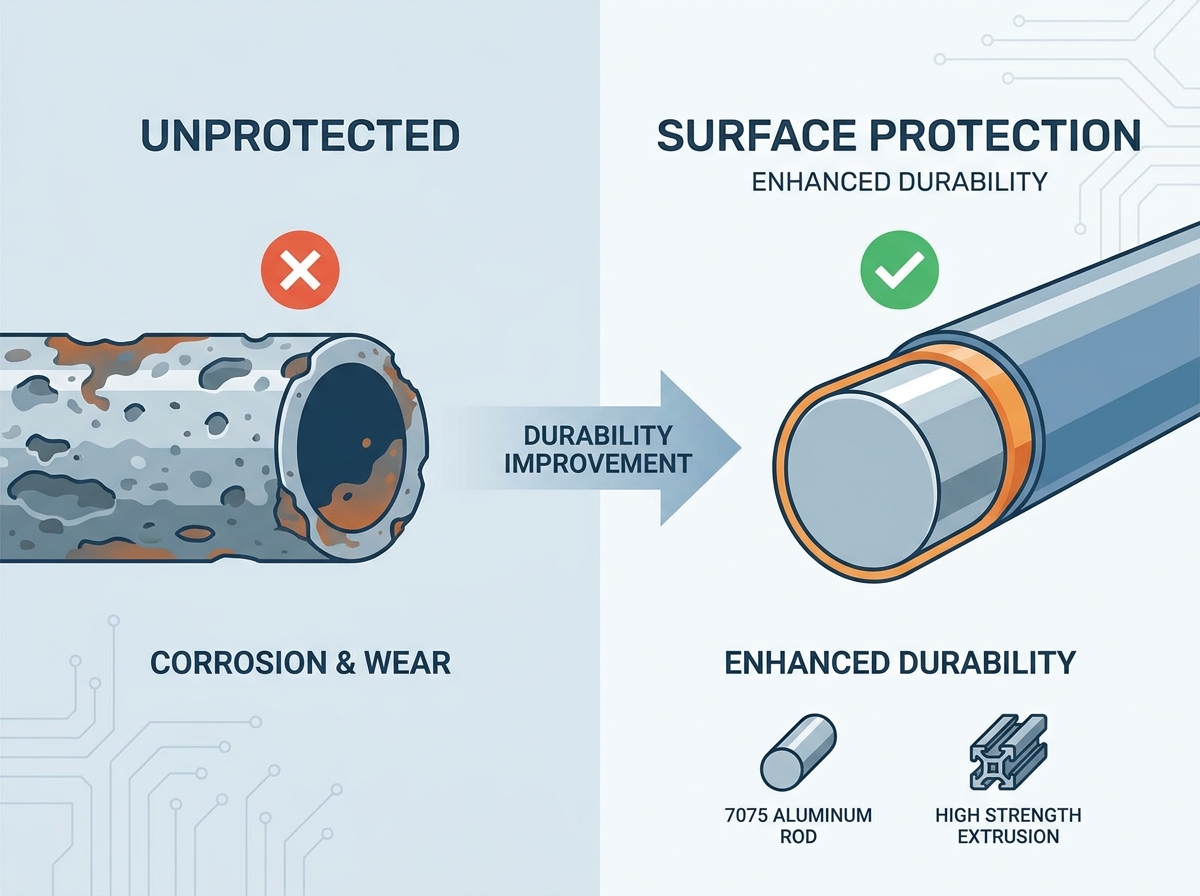
Engineers constantly face a fundamental material trade-off when designing load-bearing structures. The ultra-high tensile strength of zinc-alloyed 7000 series aluminum comes at a steep cost. These specific alloys exhibit a heightened susceptibility to stress-corrosion cracking (SCC) and galvanic corrosion compared to other aluminum grades. Untreated high-strength components deployed in aerospace, marine, or heavy industrial environments face rapid degradation. This premature wear leads to catastrophic part failure, unplanned system downtime, and inflated lifecycle maintenance demands.
Achieving maximum operational lifespan requires a proactive approach. You must integrate engineered surface protection strategies early in the design phase. Relying solely on baseline material selection is no longer sufficient for demanding applications. Shifting the focus toward holistic component durability ensures that high-stress parts maintain their structural integrity in harsh environments. Proper surface treatments transform vulnerable alloys into resilient, long-lasting components capable of surviving severe operational conditions.
Inherent Vulnerability: The high zinc content that gives the 7000 series its exceptional strength-to-weight ratio simultaneously lowers its natural corrosion resistance compared to 5000 or 6000 series alloys.
Impurity Influence: Minimizing iron and silicon impurities is highly critical to improving both the baseline fracture toughness and the overall quality/responsiveness of subsequent surface treatments.
Measurable Impact: Appropriate surface treatments can reduce corrosion rates by up to 40% in standardized salt spray tests while preserving core mechanical properties.
Tolerance Management: Selecting a protection method requires balancing environmental resistance with strict dimensional tolerances, particularly for precision-machined parts or high strength aluminum extrusion profiles.
Regulatory Compliance: Modern surface protection strategies must account for evolving environmental regulations (e.g., RoHS, REACH), necessitating a shift away from legacy hexavalent chromium treatments.
The metallurgical reality of 7000 series alloys centers on zinc and magnesium additions. These alloying elements create high-strength precipitates within the aluminum matrix during the aging process. These precipitates provide exceptional load-bearing capabilities, often rivaling certain steel grades. However, they also form localized anodic zones across the microstructure. These microscopic zones accelerate localized corrosion when exposed to electrolytes like saltwater or industrial chemicals. The very elements that give the alloy its impressive yield strength create direct pathways for environmental degradation. When moisture bridges the gap between the anodic precipitates and the cathodic aluminum matrix, a micro-galvanic cell forms, rapidly eating away at the grain boundaries.
Understanding this mechanism is vital for structural engineers. You cannot specify a 7075-T6 component for an exposed marine application without accounting for this inherent vulnerability. The zinc-rich grain boundaries will suffer from intergranular corrosion, leading to exfoliation where the surface layers literally peel away. This structural degradation compromises the load path, leading to sudden and unpredictable mechanical failures under stress.
Industry debates often surround the baseline corrosion resistance of these alloys. In dry, controlled atmospheric conditions, the material exhibits moderate stability. Performance changes drastically in severe media. The alloy degrades rapidly when exposed to seawater, industrial acids, or alkaline salts. Without protective barrier coatings, pitting and exfoliation corrosion compromise structural integrity within months. Bare 7000 series components simply cannot survive prolonged exposure to harsh electrolytes.
Environment Type | Exposure Conditions | Bare 7000 Series Response | Primary Failure Mode |
|---|---|---|---|
Controlled Indoor | Low humidity, stable temp | Stable, minimal oxidation | None expected |
Urban Atmospheric | Moderate humidity, pollutants | Slow surface dulling, minor pitting | Cosmetic degradation |
Marine / Coastal | High salt, high moisture | Rapid intergranular attack | Exfoliation, SCC |
Industrial Chemical | Acidic or alkaline exposure | Severe localized dissolution | Deep pitting, structural loss |
Alloy purity directly impacts both mechanical and chemical stability. Reducing iron (Fe) and silicon (Si) impurities enhances fracture toughness. Transitioning from standard 7075 to higher-purity variants like 7050 or 7049 minimizes the formation of secondary phase particles. These insoluble particles disrupt the uniform application of surface coatings. Cleaner alloys respond better to chemical treatments. They allow for more consistent anodic layers and tighter plating adhesion.
When specifying materials for critical aerospace bulkheads or high-pressure hydraulic manifolds, engineers often mandate tight controls on these trace elements. High iron content creates large constituent particles that act as stress concentrators. During the anodizing process, these iron-rich particles do not convert to aluminum oxide. Instead, they dissolve or remain as defects in the coating, creating microscopic voids. These voids serve as direct channels for corrosive media to reach the bare substrate, entirely defeating the purpose of the protective layer.
Heat treatments dictate baseline environmental resistance. Specific quenching and aging protocols improve stress-corrosion cracking (SCC) resistance. The T73 temper overages the alloy, sacrificing a small amount of strength for vastly superior SCC performance compared to the peak-strength T6 temper. Tempering establishes the foundation for durability. It must act as a base for secondary surface protection, never as a complete replacement for it.
The T76 temper offers a middle ground, providing better exfoliation corrosion resistance than T6 while retaining higher strength than T73. Selecting the correct temper requires analyzing the directional stresses the component will face. Short-transverse stresses in thick sections are particularly vulnerable to SCC. By utilizing a T73 or T74 temper, you alter the size and distribution of the zinc-magnesium precipitates across the grain boundaries, reducing the continuous anodic path that facilitates rapid cracking.
Hard coat anodizing relies on the electrochemical conversion of the aluminum surface. This process grows a thick, porous aluminum oxide layer directly from the substrate. The outcome delivers exceptional wear resistance and high dielectric strength. It provides significant corrosion protection in abrasive environments. However, the rigid oxide layer reduces the fatigue strength of the component. Operators must precisely calculate dimensional growth. The high zinc content requires specialized bath chemistry modifications to prevent burning during the anodizing process.
To successfully apply Type III anodizing to high-zinc alloys, finishing facilities must follow strict operational parameters:
Maintain bath temperatures strictly between 28°F and 32°F to prevent the acid from dissolving the coating as it forms.
Utilize a slow voltage ramp-up to prevent current spikes that cause localized burning around zinc precipitates.
Implement high-agitation air sparging to dissipate heat generated at the part surface during the electrochemical conversion.
Limit the maximum coating thickness to 0.002 inches to prevent excessive micro-cracking in the brittle oxide layer.
Chem film treatments utilize a chemical reaction to create a protective chromate film. This thin layer serves as an excellent base for paint and primer adhesion. It uniquely retains the electrical conductivity of the aluminum surface. The trade-off is a much thinner barrier compared to anodizing. It offers less physical protection against abrasion. Furthermore, facilities face strict regulatory scrutiny. The industry is actively shifting from toxic hexavalent chromium to safer trivalent chromium formulations.
Applying MIL-DTL-5541 Type II (trivalent) coatings requires meticulous surface preparation. The 7000 series alloys develop a tenacious natural oxide layer that must be completely stripped. If the desmutting step fails to remove the copper and zinc smuts left behind by the alkaline etch, the conversion coating will be patchy and non-adherent. A properly applied chem film provides up to 168 hours of salt spray resistance on its own, but its primary value lies in acting as a tie-coat for subsequent epoxy primers and polyurethane topcoats.
Electroless nickel plating uses autocatalytic chemical reduction. It deposits a uniform nickel-phosphorus alloy across the entire part. This method yields superior corrosion resistance and high lubricity. It maintains uniform thickness regardless of complex part geometry. The primary trade-off is higher processing expense. There is also a severe risk of galvanic corrosion. If the nickel plating scratches, the highly anodic aluminum substrate underneath corrodes rapidly.
The pre-treatment cycle for electroless nickel on zinc-alloyed aluminum is notoriously difficult. You cannot plate directly onto the aluminum. The process requires a double zincate treatment. The first zincate layer dissolves the natural aluminum oxide and deposits a thin layer of zinc. This layer is stripped off in nitric acid, and a second, much denser zincate layer is applied. This secondary layer provides the necessary foundation for the electroless nickel strike. Any misstep in this sequence results in blistering and catastrophic peeling of the nickel plate under operational loads.
Powder coating involves the electrostatic application of dry polymer powder. The part is then cured under heat to form a continuous, durable barrier. This provides high impact resistance and broad chemical resistance. It also offers vast aesthetic flexibility. The main drawback is the significant thickness added to the component. It requires a properly pre-treated substrate, often chem film or a light anodize, to ensure optimal adhesion and prevent under-film corrosion.
When specifying powder coats for heavy industrial equipment, engineers must select the correct polymer chemistry. TGIC-polyester powders offer excellent UV stability for outdoor exposure. Epoxy powders provide superior chemical resistance but chalk rapidly under sunlight. For marine environments, a dual-coat system consisting of a zinc-rich epoxy primer followed by a super-durable polyester topcoat provides the most robust defense against moisture permeation and salt attack.
Protection Method | Typical Thickness (inches) | Fatigue Impact | Best Application |
|---|---|---|---|
Hard Coat Anodizing | 0.001 - 0.002 | Significant Reduction | High-friction mechanical parts |
Chem Film (Type II) | 0.00001 - 0.00003 | Negligible | Paint prep, electrical housings |
Electroless Nickel | 0.0005 - 0.003 | Moderate Reduction | Complex geometries, valves |
Powder Coating | 0.002 - 0.006 | Negligible | External structural components |
Applications requiring high axial load capacity demand precise protection. A 7075 aluminum rod used in aerospace fasteners or actuator shafts faces intense mechanical stress. You must evaluate treatments that protect against fretting corrosion and fatigue failure. Heavy anodizing might compromise the rod's structural integrity under cyclic loading. Thin-film solid film lubricants or specialized nickel platings often provide the necessary environmental barrier without degrading the core tensile properties.
When designing actuator shafts, dimensional tolerance is critical. A standard Type III anodize will grow the rod's diameter by approximately half the total coating thickness. If you specify a 0.002-inch coating, the rod's diameter increases by 0.002 inches total (0.001 per side). This growth can cause interference fits in tight bearing assemblies. Engineers must machine the raw rod undersize to accommodate this specific growth, ensuring the final coated dimension meets the required engineering drawing tolerances.
Applying uniform protection to complex, multi-cavity profiles presents unique challenges. A high strength aluminum extrusion often features internal channels and tight corners. Line-of-sight processes like powder coating struggle to reach these internal surfaces due to the Faraday cage effect. You must utilize high-penetration treatments. Electroless nickel or specialized immersion anodizing ensures internal channels are adequately protected against moisture pooling and subsequent hidden corrosion.
Extrusion geometry dictates the coating strategy. Hollow profiles used in structural framing trap condensation. If left bare, the inside of the extrusion will corrode outward, remaining undetected until structural failure occurs. To mitigate this, manufacturers often employ a dip-spin coating process using zinc-flake formulations, or they specify a full-immersion chem film followed by a low-viscosity epoxy wash primer that flows through the internal cavities, sealing the raw aluminum from trapped moisture.
3D-printed components introduce distinct surface protection hurdles. Powder-bed fusion parts exhibit high surface roughness, micro-porosity, and residual thermal stresses. Standard coatings fail on these uneven surfaces. You must implement rigorous pre-treatment and post-build surface consolidation steps. Hot isostatic pressing (HIP) closes internal voids. Abrasive bead blasting smooths the exterior. These steps make printed surfaces receptive to uniform, defect-free protective coatings.
The inherent surface roughness of as-printed parts traps plating solutions and anodizing acids. If these harsh chemicals are not completely neutralized and rinsed from the micro-pores, they will bleed out over time, destroying the applied coating from underneath. Mechanical polishing or chemical milling is often required to remove the outer 50-100 microns of the printed surface, exposing a denser, more uniform substrate that behaves predictably during the final finishing operations.
Engineers must calculate machining allowances before specifying a finish. Plating and powder coating are additive processes. They build material on top of the existing surface. Anodizing is both penetrative and additive. It consumes the base metal while growing outward. You must account for this dimensional shift during the CAD design phase to ensure final assembly tolerances remain within specification.
Consider a precision bore designed to house a press-fit bearing. If you specify electroless nickel plating with a thickness of 0.001 inches, the bore diameter will shrink by 0.002 inches. If you fail to communicate this to the machining center, the final coated part will be out of tolerance, resulting in expensive scrap. Always annotate engineering drawings with clear instructions indicating whether dimensions apply before or after coating.
Match the environmental threats directly to the optimal coating chemistry. Salt spray exposure requires dense, non-porous barriers like electroless nickel. UV exposure degrades certain polymers, necessitating UV-stable topcoats. Chemical contact demands specific fluoropolymer or epoxy resistance. Abrasion requires the extreme hardness of Type III anodizing. Define the primary failure mode before selecting the surface treatment.
For components facing a combination of threats, multi-layer systems are necessary. A military ground vehicle component might face severe abrasion from sand, chemical attack from hydraulic fluid, and galvanic corrosion from steel fasteners. In this scenario, a Type III hard coat anodize sealed with sodium dichromate, followed by a localized application of dielectric joint compound at the fastener interfaces, provides the comprehensive defense required for field survival.
Navigating chemical regulations is mandatory. You must ensure compliance with RoHS and REACH directives. Aerospace applications require strict adherence to specific MIL-SPECs. Specify trivalent chromium over hexavalent variants. Ensure your finishing partners maintain compliant wastewater treatment facilities. Regulatory non-compliance can halt production and force costly redesigns of your finishing specifications.
The transition away from hexavalent chromium (Cr6) has forced the industry to adopt new qualification testing. Trivalent chromium (Cr3) formulations behave differently during application. They do not offer the same "self-healing" properties as legacy Cr6 coatings if scratched. Engineers must validate these newer coatings through rigorous salt spray testing (ASTM B117) to ensure they meet the specific performance thresholds demanded by the end-user.
Evaluate the upfront cost of advanced surface treatments against long-term operational savings. Cheaper initial coatings often fail prematurely in harsh environments. This leads to rapid component replacement and system downtime. Investing in premium finishes extends component life and reduces maintenance cycles. Calculate the return on investment based on the extended operational hours gained through proper surface engineering.
A standard anodize might cost less per square foot, but if it fails after 500 hours in a marine environment, the labor costs associated with replacing the corroded part far exceed the initial savings. Specifying a high-phosphorus electroless nickel plate increases the upfront finishing cost but can extend the component's service life to over 5,000 hours in the same environment, drastically reducing the frequency of field maintenance.
Surface preparation dictates coating success. Improper degreasing leaves machining oils on the substrate. Inadequate desmutting fails to remove alloying elements drawn to the surface during etching. These errors lead to catastrophic adhesion failure or uneven coating buildup. You must enforce strict chemical bath maintenance and validate water break tests to ensure a perfectly clean substrate prior to any coating application.
The high copper and zinc content in 7000 series alloys creates a heavy, dark smut during alkaline etching. Standard nitric acid desmuts often struggle to remove this residue completely. Finishing shops must utilize specialized tri-acid desmutting solutions containing nitric, sulfuric, and hydrofluoric acids to effectively dissolve the heavy metallic smut and expose the active aluminum surface required for proper coating adhesion.
Curing temperatures pose a significant risk to high-strength alloys. Powder coats and specific platings require thermal baking. If these curing temperatures exceed the original aging temperature of the aluminum temper, the part will inadvertently anneal. This destroys the mechanical strength of the component. Always verify that finishing temperatures remain safely below the alloy's critical phase-change thresholds.
For example, 7075-T6 is artificially aged at approximately 250°F (121°C). Many standard powder coating powders require curing temperatures of 350°F to 400°F (175°C to 205°C). Baking a 7075-T6 part at 400°F for 20 minutes will overage the material, permanently reducing its yield strength. Engineers must specify low-temperature cure powders or utilize alternative room-temperature curing wet paints to preserve the alloy's mechanical properties.
Multi-material assemblies create galvanic corrosion hazards. Placing protected 7000 series components directly against stainless steel or titanium accelerates localized corrosion if the coating scratches. You must isolate dissimilar metals. Use dielectric shims, non-conductive sealants, or specialized joint compounds. Breaking the electrical pathway prevents the aluminum from acting as a sacrificial anode within the assembly.
When assembling a 7075 aluminum bracket to a carbon fiber composite structure, the risk is severe. Carbon fiber is highly cathodic. If moisture bridges the gap between the bare aluminum and the carbon fibers, the aluminum will corrode rapidly. You must apply a robust barrier coating to the aluminum and install a layer of fiberglass isolation tape or a wet-installed polysulfide sealant between the two materials to prevent direct electrical contact.
High-strength zinc-alloyed aluminum cannot reach its full operational potential in demanding environments without engineered surface protection. Baseline mechanical properties mean nothing if the component dissolves in salt spray. You must prioritize Hard Coat Anodizing for wear resistance. Select Chem Film for conductivity and paint preparation. Utilize Electroless Nickel for complex geometries requiring extreme corrosion resistance.
Consult with a metallurgical engineer to match the specific coating chemistry to your anticipated environmental threats.
Conduct application-specific salt spray testing on sample coupons to validate the chosen finish.
Perform prototype validation to verify that dimensional tolerances remain within specification after the coating process.
Audit your finishing partner to ensure strict adherence to REACH, RoHS, and required military specifications.
A: The 7000 series contains high levels of zinc and copper to achieve its superior strength. These alloying elements precipitate out during heat treatment, creating microscopic anodic and cathodic zones. This structure forms internal micro-galvanic cells that accelerate localized corrosion when exposed to moisture.
A: Iron and silicon form insoluble, cathode-like intermetallic phases within the aluminum matrix. These particles interrupt the formation of continuous protective oxide films. This disruption creates weak points on the surface, accelerating localized galvanic activity and severe pitting corrosion.
A: Yes, but it requires precise control. The high zinc and copper content makes 7075 highly conductive and prone to dissolving in the acid bath. Anodizers must use specialized bath chemistries, lower temperatures, and modified voltage ramp rates to prevent burning and ensure even oxide formation.
A: Core tensile strength remains largely unaffected by most surface treatments. However, processes like Type III hard coat anodizing create a brittle, rigid surface layer. This rigid layer can serve as a crack initiation site, significantly reducing the overall fatigue life of the extrusion under cyclic loading.
A: For marine applications, electroless nickel plating or a robust marine-grade epoxy powder coat applied over a chem film base provides the best defense. These methods create dense, non-porous barriers that prevent highly conductive saltwater from reaching the vulnerable aluminum substrate.